Ch. 7 The Nervous System
Marieb - Essentials of Human Anatomy & Physiology 13th Edition
Marieb13th EditionEssentials of Human Anatomy & PhysiologyISBN: 9780135624340Not the one you use?Change textbook
Chapter 7, Problem 12

Which of the following is true of the autonomic, but not the somatic, nervous system?
a. Neurotransmitter is acetylcholine
b. Axons are myelinated
c. Effectors are muscle cells
d. It has motor neurons located in ganglia

Verified step by step guidance
1
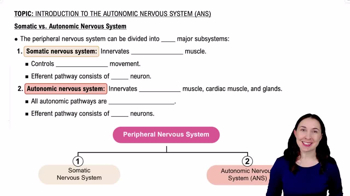
Step 1: Understand the difference between the autonomic and somatic nervous systems. The autonomic nervous system (ANS) controls involuntary functions like heart rate, digestion, and glandular activity, while the somatic nervous system (SNS) controls voluntary movements of skeletal muscles.
Step 2: Analyze each option provided in the question. For example, option (a) states that the neurotransmitter is acetylcholine. While acetylcholine is used in both the autonomic and somatic systems, the autonomic system also uses other neurotransmitters like norepinephrine, depending on the division (sympathetic or parasympathetic).
Step 3: Evaluate option (b), which states that axons are myelinated. Both the autonomic and somatic systems can have myelinated axons, but the autonomic system also has unmyelinated axons in postganglionic neurons.
Step 4: Consider option (c), which states that effectors are muscle cells. The somatic system targets skeletal muscle cells, while the autonomic system targets smooth muscle, cardiac muscle, and glands. This distinction is key to understanding the difference.
Step 5: Examine option (d), which states that motor neurons are located in ganglia. This is true for the autonomic nervous system, as it has a two-neuron chain (preganglionic and postganglionic neurons) with synapses occurring in ganglia. The somatic system does not have motor neurons located in ganglia.

Verified video answer for a similar problem:

This video solution was recommended by our tutors as helpful for the problem above.
Video duration:
4m
Was this helpful?

Key Concepts

Here are the essential concepts you must grasp in order to answer the question correctly.

Autonomic Nervous System

The autonomic nervous system (ANS) regulates involuntary bodily functions, such as heart rate, digestion, and respiratory rate. It operates without conscious control and is divided into the sympathetic and parasympathetic systems, which work to maintain homeostasis. Understanding the ANS is crucial for distinguishing its functions from those of the somatic nervous system.
Recommended video:
1:50
Somatic vs. Autonomic Nervous System

Somatic Nervous System

The somatic nervous system (SNS) is responsible for voluntary movements and the transmission of sensory information to the central nervous system. It primarily controls skeletal muscles and is characterized by myelinated axons that facilitate rapid signal transmission. Recognizing the differences between the SNS and ANS helps clarify their distinct roles in the nervous system.
Recommended video:
1:50
Somatic vs. Autonomic Nervous System

Neurotransmitters and Ganglia

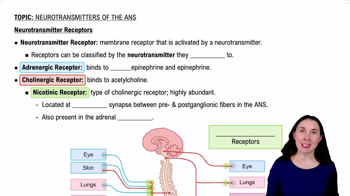
Neurotransmitters are chemical messengers that transmit signals across synapses between neurons. In the ANS, acetylcholine is a key neurotransmitter, particularly in the parasympathetic division. Additionally, the ANS has motor neurons located in ganglia, which are clusters of nerve cell bodies outside the central nervous system, contrasting with the direct pathways of the SNS.
Recommended video:
2:30
Neurotransmitter Receptors