What is a transition state?
a. the shape adopted by an enzyme that has an inhibitory molecule bound at its active site
b. the amount of kinetic energy required for a reaction to proceed
c. the intermediate complex formed as covalent bonds in the reactants are being broken and re-formed during a reaction
d. the enzyme shape after binding an allosteric regulatory molecule
Verified step by step guidance
1
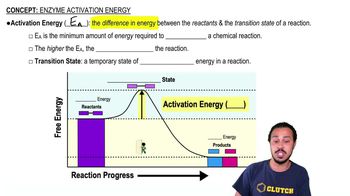
Identify the key elements in the reaction progress diagram: Reactants, Products, and the energy levels (A, B, C).
Understand that the transition state is the highest energy point along the reaction path, which is represented by the peak of the curve (A).
Recognize that the transition state is an intermediate complex where old bonds are breaking and new bonds are forming.
Compare the given options with the definition of the transition state: the intermediate complex formed as covalent bonds in the reactants are being broken and re-formed during a reaction.
Select the option that matches this definition: option c.
Verified video answer for a similar problem:
This video solution was recommended by our tutors as helpful for the problem above.
Video duration:
4m
Play a video:
0 Comments
Key Concepts
Here are the essential concepts you must grasp in order to answer the question correctly.
Transition State
The transition state is a high-energy, unstable arrangement of atoms that occurs during a chemical reaction. It represents the point at which reactants are in the process of being converted into products, characterized by the breaking and forming of bonds. This state is crucial for understanding reaction kinetics, as it determines the activation energy required for the reaction to proceed.
Activation energy is the minimum amount of energy required for a chemical reaction to occur. It is the energy barrier that must be overcome for reactants to reach the transition state. The concept is essential in understanding how catalysts can lower this energy requirement, thereby increasing the rate of reaction without being consumed in the process.
A reaction coordinate diagram visually represents the energy changes during a chemical reaction. It plots the energy of the system against the progress of the reaction, illustrating the energy of reactants, products, and the transition state. This diagram helps in understanding the energy landscape of a reaction, including the activation energy and the stability of intermediates.

 4:45 minutes
 Verified step by step guidance
 08:59
08:59