Ch. 12 The Lymphatic System and Body Defenses
Marieb - Essentials of Human Anatomy & Physiology 13th Edition
Marieb13th EditionEssentials of Human Anatomy & PhysiologyISBN: 9780135624340Not the one you use?Change textbook
Chapter 12, Problem 7

More than one choice may apply.
Chemical mediators of inflammation include
a. Interferon
b. Complement
c. Histamine
d. Antibodies

Verified step by step guidance
1
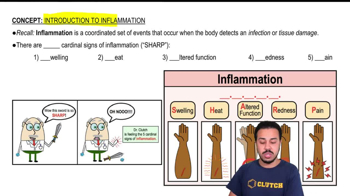
Step 1: Begin by understanding the concept of inflammation. Inflammation is the body's response to injury or infection, and it involves various chemical mediators that help initiate and regulate the process.
Step 2: Review the role of chemical mediators in inflammation. These mediators are substances released by cells or tissues to promote vasodilation, increase vascular permeability, recruit immune cells, and facilitate tissue repair.
Step 3: Analyze each option provided in the question: - Interferon: Understand that interferons are proteins primarily involved in antiviral responses, not directly in inflammation. - Complement: Learn that the complement system is a group of proteins that enhance immune responses, including inflammation, by promoting phagocytosis and cell lysis. - Histamine: Recognize that histamine is a key mediator of inflammation, responsible for vasodilation and increased vascular permeability. - Antibodies: Note that antibodies are part of the adaptive immune system and are not direct chemical mediators of inflammation.
Step 4: Identify which options are directly involved in the inflammatory process based on their functions. Focus on complement and histamine as they are chemical mediators of inflammation.
Step 5: Conclude by eliminating options that do not directly mediate inflammation (e.g., interferon and antibodies) and selecting the correct choices based on their roles in the inflammatory response.

Verified video answer for a similar problem:

This video solution was recommended by our tutors as helpful for the problem above.
Video duration:
3m
Was this helpful?

Key Concepts

Here are the essential concepts you must grasp in order to answer the question correctly.

Chemical Mediators of Inflammation

Chemical mediators of inflammation are substances released by cells in response to injury or infection that facilitate the inflammatory response. They include a variety of molecules such as cytokines, histamines, and complement proteins, which help to regulate blood flow, attract immune cells, and promote healing.
Recommended video:
1:38
Inflammation

Histamine

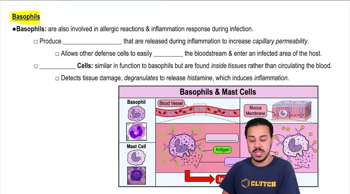
Histamine is a biogenic amine that plays a crucial role in the inflammatory response. It is released by mast cells and basophils and causes vasodilation and increased permeability of blood vessels, leading to the classic signs of inflammation such as redness and swelling. Histamine also contributes to the recruitment of other immune cells to the site of injury.
Recommended video:
3:10
Basophils

Complement System

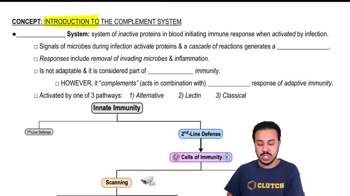
The complement system is a group of proteins that work together to enhance the immune response. It can be activated by pathogens or antibodies and leads to a cascade of reactions that promote inflammation, opsonization of pathogens, and formation of the membrane attack complex, which can directly lyse pathogens. This system is vital for both innate and adaptive immunity.
Recommended video:
4:25
Complement System