Ch. 12 The Lymphatic System and Body Defenses
Marieb - Essentials of Human Anatomy & Physiology 13th Edition
Marieb13th EditionEssentials of Human Anatomy & PhysiologyISBN: 9780135624340Not the one you use?Change textbook
Chapter 12, Problem 19

Describe the specific roles of helper, cytotoxic, and regulatory T cells in cell-mediated immunity. Which is thought to be disabled in AIDS?

Verified step by step guidance
1
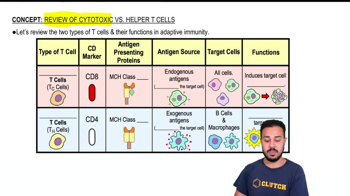
Helper T cells (CD4+ T cells) play a central role in cell-mediated immunity by activating other immune cells. They release cytokines to stimulate the activity of cytotoxic T cells and B cells, enhancing the immune response.
Cytotoxic T cells (CD8+ T cells) are responsible for directly attacking and destroying infected cells, cancer cells, or foreign cells. They recognize antigens presented by infected cells and induce apoptosis (programmed cell death) in these target cells.
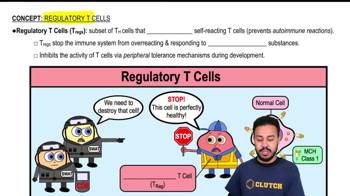
Regulatory T cells (Tregs) help maintain immune system balance by suppressing excessive immune responses. They prevent autoimmune reactions by ensuring the immune system does not attack the body's own tissues.
In AIDS (Acquired Immunodeficiency Syndrome), helper T cells (CD4+ T cells) are specifically targeted and destroyed by the HIV virus. This leads to a weakened immune system, as the activation and coordination of other immune cells are compromised.
The loss of helper T cells in AIDS results in a reduced ability to fight infections and diseases, making the body vulnerable to opportunistic infections and certain cancers.

Verified video answer for a similar problem:

This video solution was recommended by our tutors as helpful for the problem above.
Video duration:
4m
Was this helpful?

Key Concepts

Here are the essential concepts you must grasp in order to answer the question correctly.

Helper T Cells

Helper T cells, or CD4+ T cells, play a crucial role in the immune response by activating other immune cells, including B cells and cytotoxic T cells. They release cytokines that enhance the immune response, helping to coordinate the body's defense against pathogens. Their proper functioning is essential for a robust immune system.
Recommended video:
4:27
Review of Cytotoxic vs Helper T Cells

Cytotoxic T Cells

Cytotoxic T cells, or CD8+ T cells, are responsible for directly killing infected or cancerous cells. They recognize specific antigens presented by infected cells and release perforins and granzymes to induce apoptosis in these target cells. This action is vital for controlling infections and eliminating tumor cells.
Recommended video:
4:27
Review of Cytotoxic vs Helper T Cells

Regulatory T Cells

Regulatory T cells, or Tregs, help maintain immune tolerance and prevent autoimmune responses by suppressing the activity of other immune cells. They play a critical role in modulating the immune response to ensure it is appropriate and not overly aggressive. In the context of AIDS, the depletion of helper T cells impairs the overall immune response, including the function of regulatory T cells.
Recommended video:
3:53
Regulatory T Cells
Related Practice
Textbook Question

Binding of antigens to receptors of immunocompetent lymphocytes leads to clonal selection. Describe the process of clonal selection. What nonlymphocyte cell is a central actor in this process, and what is its function?

1
views
Textbook Question

Interferons are referred to as antiviral proteins. What stimulates their production, and how do they protect uninfected cells?

1
views
Textbook Question

Mrs. Morrow, a 59-year-old woman, has undergone a left radical mastectomy (removal of the left breast and left axillary lymph nodes and vessels). Her left arm is severely swollen and painful, and she is unable to raise it more than shoulder height.

(a) Explain her signs and symptoms.

(b) Can she expect relief from these symptoms in time? How so?

2
views
Textbook Question

Mr. James, an 80-year-old man, is grumbling about having to receive a flu shot every year. Flu viruses have a high mutation rate (undergo rapid genetic changes), which results in the appearance of new proteins on the flu virus's 'coat.' How does this help explain the need to get a flu shot each year?

1
views
Textbook Question

What is complement? Besides bacterial lysis, what are some of the roles of complement?

2
views
Textbook Question

Name the five classes of immunoglobulins. Which is most likely to be found attached to a B cell membrane? Which is most abundant in plasma? Which is important in allergic responses? Which is the first Ig to be released during the primary response? Which can cross the placental barrier?

1
views