Match the following antibodies with the correct definition. ____IgD ____IgM ____IgG ____IgA ____IgE a. Antibody found in secretions b. Most common antibody; crosses the placenta c. Antibody involved in allergies and parasitic infections d. Pentamer and potent agglutinating agent e. Antibody bound to the B cell plasma membrane
Verified step by step guidance
1
Step 1: Understand the function and location of each antibody type. Antibodies (immunoglobulins) are specialized proteins produced by B cells to help the immune system fight pathogens. Each type has a unique role and location in the body.
Step 2: Match IgD with its definition. IgD is primarily found bound to the plasma membrane of immature B cells and plays a role in initiating B cell activation. Therefore, it corresponds to definition 'e'.
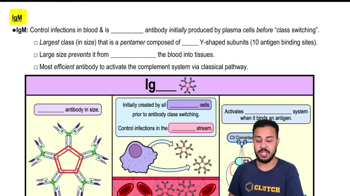
Step 3: Match IgM with its definition. IgM is the first antibody produced during an immune response. It is a pentamer and is highly effective at agglutinating pathogens. This matches definition 'd'.
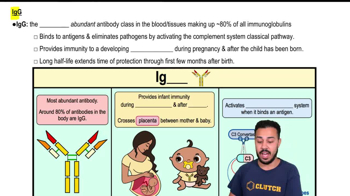
Step 4: Match IgG with its definition. IgG is the most abundant antibody in the blood and extracellular fluid. It can cross the placenta to provide passive immunity to the fetus. This corresponds to definition 'b'.
Step 5: Match IgA and IgE with their definitions. IgA is found in secretions like saliva, tears, and mucus, matching definition 'a'. IgE is involved in allergic reactions and defense against parasitic infections, matching definition 'c'.
Verified video answer for a similar problem:
This video solution was recommended by our tutors as helpful for the problem above
Play a video:
0 Comments
Key Concepts
Here are the essential concepts you must grasp in order to answer the question correctly.
Types of Immunoglobulins
Immunoglobulins, or antibodies, are specialized proteins produced by B cells that play a crucial role in the immune response. There are five main classes: IgA, IgD, IgE, IgG, and IgM, each with distinct functions and locations in the body. Understanding these types is essential for matching them to their definitions, as each class has unique characteristics and roles in immune defense.
IgG is the most abundant antibody in the bloodstream and is known for its ability to cross the placenta, providing passive immunity to the fetus. It plays a vital role in the secondary immune response, neutralizing toxins and pathogens, and facilitating opsonization, which enhances phagocytosis. Recognizing its significance helps in identifying its correct definition in the matching exercise.
IgM is the first antibody produced in response to an infection and is typically found in a pentameric form, making it an effective agglutinating agent. It is primarily present in the blood and lymphatic fluid and is crucial for the initial stages of the immune response. Understanding its structure and function is key to accurately matching it with its definition.