Ch. 8 Articulations
Amerman - Human Anatomy & Physiology 2nd Edition
Amerman2nd EditionHuman Anatomy & PhysiologyISBN: 9780136873822Not the one you use?Change textbook
Chapter 8, Problem L2.1c

Explain how the structure of each of the following joint types follows its function.
Synovial joint

Verified step by step guidance
1
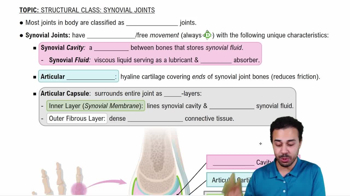
Understand the basic structure of synovial joints: Synovial joints are characterized by the presence of a synovial cavity filled with synovial fluid, which reduces friction and allows for smooth movement between articulating bones.
Examine the role of articular cartilage: The ends of the bones in synovial joints are covered with articular cartilage, a smooth and resilient tissue that absorbs shock and reduces friction during movement.
Analyze the function of the joint capsule: The joint capsule is a tough, fibrous structure that encloses the synovial cavity and provides stability to the joint while allowing for mobility.
Explore the importance of ligaments: Ligaments are strong bands of connective tissue that reinforce the joint capsule and help stabilize the joint by preventing excessive movement.
Consider the role of accessory structures: Synovial joints often include additional structures such as bursae (fluid-filled sacs) and menisci (cartilage pads) that further reduce friction, distribute weight, and enhance joint function.

Verified video answer for a similar problem:

This video solution was recommended by our tutors as helpful for the problem above.
Was this helpful?

Key Concepts

Here are the essential concepts you must grasp in order to answer the question correctly.

Synovial Joint Structure

Synovial joints are characterized by a fluid-filled joint cavity, which allows for a wide range of motion. They consist of articular cartilage covering the ends of bones, a synovial membrane that secretes synovial fluid for lubrication, and ligaments that provide stability. This structure enables flexibility and movement while minimizing friction during activities.
Recommended video:
8:20
Synovial Joints

Function of Synovial Joints

The primary function of synovial joints is to facilitate movement between bones while providing stability. They allow for various types of motion, including flexion, extension, rotation, and gliding, depending on the specific joint type (e.g., hinge, ball-and-socket). This functional versatility is essential for activities ranging from walking to throwing.
Recommended video:
8:20
Synovial Joints

Biomechanics of Joint Movement

Biomechanics involves the study of the mechanical laws relating to the movement or structure of living organisms. In the context of synovial joints, it examines how forces are applied during movement and how the joint's structure supports these forces. Understanding biomechanics helps explain how joint design optimizes function and reduces the risk of injury.
Recommended video:
05:39
Introduction to Joints