Ch. 13 The Peripheral Nervous System and Reflex Activity
Marieb - Human Anatomy & Physiology 11th Edition
Marieb, Hoehn11th EditionHuman Anatomy & PhysiologyISBN: 9780136874034Not the one you use?Change textbook
Chapter 13, Problem 10

A reflex that causes reciprocal activation of the antagonist muscle is the
(a) crossed-extensor
(b) flexor
(c) tendon
(d) muscle stretch.

Verified step by step guidance
1
Step 1: Understand the concept of reciprocal activation in muscle reflexes. Reciprocal activation refers to the process where the contraction of one muscle (the agonist) is accompanied by the relaxation of its opposing muscle (the antagonist).
Step 2: Review the types of reflexes listed: crossed-extensor, flexor, tendon, and muscle stretch reflexes, and identify which one involves reciprocal activation.
Step 3: Recall that the muscle stretch reflex involves the muscle spindle detecting stretch and causing the agonist muscle to contract while simultaneously inhibiting the antagonist muscle through reciprocal inhibition.
Step 4: Recognize that the flexor reflex primarily causes withdrawal of a limb and does not necessarily involve reciprocal activation of the antagonist muscle in the same way.
Step 5: Conclude that the reflex responsible for reciprocal activation of the antagonist muscle is the muscle stretch reflex.

Key Concepts

Here are the essential concepts you must grasp in order to answer the question correctly.

Reciprocal Innervation

Reciprocal innervation is a neural mechanism where activation of one muscle (agonist) causes inhibition of its antagonist muscle, allowing smooth and coordinated movement. This process prevents muscles that oppose each other from contracting simultaneously.
Recommended video:
Guided course
02:35
Characteristic 3: Avascular but Innervated

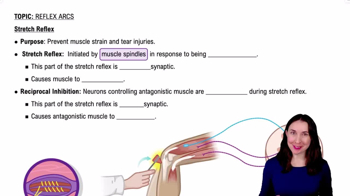
Muscle Stretch Reflex

The muscle stretch reflex is an automatic response where a muscle contracts in response to being stretched. It involves sensory receptors called muscle spindles that detect stretch and trigger motor neurons to activate the same muscle while inhibiting the antagonist.
Recommended video:
3:37
Stretch Reflex

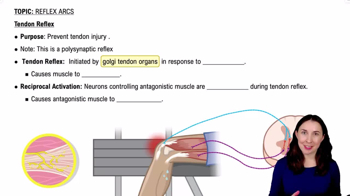
Antagonist Muscle Activation in Reflexes

Certain reflexes, like the muscle stretch reflex, involve reciprocal activation where the agonist muscle contracts and the antagonist muscle is inhibited. Understanding which reflex causes this reciprocal activation helps identify the correct reflex type.
Recommended video:
3:01
Tendon Reflex