
Textbook Question
Mark the following statements as true or false. If a statement is false, correct it to make a true statement.
Fat-containing lymph from the intestines drains into the cisterna chyli.
1
views

 Verified step by step guidance
 7:11
7:11
 5:05
5:05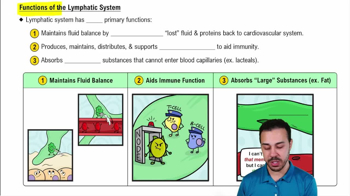 3:57
3:57Mark the following statements as true or false. If a statement is false, correct it to make a true statement.
Fat-containing lymph from the intestines drains into the cisterna chyli.
Mr. White developed neutropenia as a consequence of cancer chemotherapy, which destroyed much of his bone marrow. What other components of the immune system would be harmed by bone marrow destruction? Would you expect his hematocrit to be elevated or decreased? What effects would you expect to see from this change in hematocrit?
Carla presents to her physician with a complaint of swollen axillary lymph nodes. Her physician performs a breast exam and finds a tumor on the same side as the swollen nodes.
b. Carla undergoes surgery to have the tumor and affected lymph nodes and surrounding lymphatic vessels removed. Predict any complications Carla might have after the surgery that could arise from removal of the lymph nodes and vessels.
Carla presents to her physician with a complaint of swollen axillary lymph nodes. Her physician performs a breast exam and finds a tumor on the same side as the swollen nodes.
a. Explain what process has likely caused her nodes to swell.
Mark the following statements as true or false. If a statement is false, correct it to make a true statement.
The thymus is the site of maturation of B cells.
Mark the following statements as true or false. If a statement is false, correct it to make a true statement.
Clusters of MALT located around the oral and nasal cavities are known as Peyer's patches.