Ch. 27 Fluids & Electrolytes
Martini - Fundamentals of Anatomy & Physiology 11th Edition
Martini, Nath, Bartholomew11th EditionFundamentals of Anatomy & PhysiologyISBN: 9780136874089Not the one you use?Change textbook
Chapter 26, Problem 31

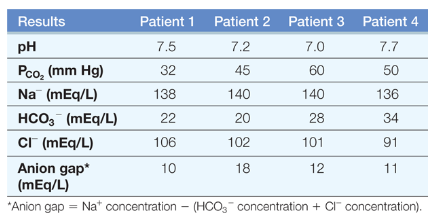
Refer to the diagnostic flowchart in Spotlight Figure 27–18. Use information from the blood test results in the accompanying table to categorize the suspected acid-base disorders of the patients represented in the table.
Table showing blood test results including pH, PCO2, Na+, HCO3-, Cl-, and anion gap for four patients.

Verified step by step guidance
1
Step 1: Understand the key parameters involved in acid-base disorders, typically including blood pH, partial pressure of carbon dioxide (pCO\_2), and bicarbonate ion concentration (HCO\_3\^-). These values help determine whether the disorder is respiratory or metabolic and whether it is acidosis or alkalosis.
Step 2: For each patient, examine the blood pH value to determine if the patient is acidotic (pH < 7.35), alkalotic (pH > 7.45), or within the normal range (7.35–7.45). This is the primary indicator of acid-base status.
Step 3: Analyze the pCO\_2 value to assess respiratory contribution. An elevated pCO\_2 suggests respiratory acidosis, while a decreased pCO\_2 suggests respiratory alkalosis. Compare this with the pH to see if the respiratory component aligns with the acid-base disturbance.
Step 4: Examine the HCO\_3\^- concentration to evaluate the metabolic component. A decreased HCO\_3\^- indicates metabolic acidosis, while an increased HCO\_3\^- indicates metabolic alkalosis. Again, compare this with the pH to confirm the metabolic disturbance.
Step 5: Use the diagnostic flowchart to integrate these values: start with pH to identify acidosis or alkalosis, then determine if the primary cause is respiratory or metabolic by comparing pCO\_2 and HCO\_3\^- levels. Finally, check for compensation by seeing if the non-primary parameter is changing in the opposite direction to partially correct the pH.

Verified video answer for a similar problem:

This video solution was recommended by our tutors as helpful for the problem above.
Was this helpful?

Key Concepts

Here are the essential concepts you must grasp in order to answer the question correctly.

Acid-Base Balance and Disorders

Acid-base balance refers to the maintenance of the proper pH in the blood, typically between 7.35 and 7.45. Disorders occur when this balance is disrupted, leading to acidosis (low pH) or alkalosis (high pH). Understanding the causes and effects of these imbalances is essential for diagnosing related conditions.
Recommended video:
01:29
Acids and Bases

Interpretation of Blood Gas Results

Blood gas analysis measures pH, partial pressure of carbon dioxide (pCO2), and bicarbonate (HCO3-) levels. These values help determine whether an acid-base disorder is respiratory or metabolic in origin and whether it is compensated or uncompensated. Accurate interpretation is key to categorizing the disorder.
Recommended video:
6:11
Functions of Blood

Use of Diagnostic Flowcharts in Clinical Assessment

Diagnostic flowcharts guide clinicians through systematic steps to analyze blood test results and identify acid-base disorders. They help integrate multiple parameters, such as pH, pCO2, and HCO3-, to reach a clear diagnosis. Familiarity with these tools improves diagnostic accuracy and decision-making.
Recommended video:
Guided course
03:47
Anatomical Terms Review