Textbook Question
List the stages of mitosis, and briefly describe the events that occur in each.
1
views

 Martini, Nath, Bartholomew 11th EditionCh. 3 The Cellular Level of OrganizationProblem 26b
 Verified step by step guidance
 01:25
01:25
 03:31
03:31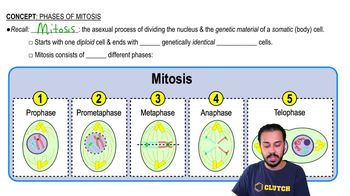 03:21
03:21List the stages of mitosis, and briefly describe the events that occur in each.
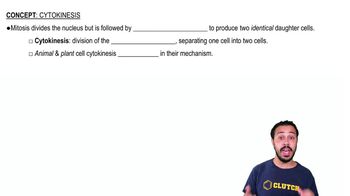
(a) What is cytokinesis?
A molecule that blocks the ion channels lining integral proteins in the plasma membrane would interfere with
(a) Cell recognition
(b) The movement of lipid-soluble molecules
(c) Producing changes in the electrical charges across a plasma membrane
(d) The ability of protein hormones to stimulate the cell
(e) The cell's ability to divide
The transport of a certain molecule exhibits the following characteristics:
(1) The molecule moves down its concentration gradient;
(2) at concentrations above a given level, the rate of transport does not increase; and
(3) cellular energy is not required for transport to occur.
Which transport process is at work?
List, in sequence, the phases of the interphase stage of the cell life cycle, and briefly describe what happens in each.
Solutions A and B are separated by a selectively permeable barrier. Over time, the level of fluid on side A increases. Which solution initially had the higher concentration of solute?