Ch. 28 The Reproductive System
Martini - Fundamentals of Anatomy & Physiology 11th Edition
Martini, Nath, Bartholomew11th EditionFundamentals of Anatomy & PhysiologyISBN: 9780136874089Not the one you use?Change textbook
Chapter 27, Problem 6

Which accessory structures contribute to the composition of semen? What are the functions of each structure?

Verified step by step guidance
1
Identify the main accessory structures involved in semen production. These typically include the seminal vesicles, prostate gland, and bulbourethral glands.
Describe the contribution of the seminal vesicles: they produce a fluid rich in fructose and prostaglandins, which provides energy for sperm and helps with sperm motility.
Explain the role of the prostate gland: it secretes a slightly alkaline fluid that helps neutralize the acidic environment of the vagina, enhancing sperm survival.
Discuss the function of the bulbourethral glands (Cowper's glands): they secrete a mucus-like fluid that lubricates the urethra and neutralizes any residual acidity before ejaculation.
Summarize how the combined secretions from these accessory structures mix with sperm from the testes to form semen, which supports sperm viability and facilitates successful fertilization.

Verified video answer for a similar problem:

This video solution was recommended by our tutors as helpful for the problem above.
Was this helpful?

Key Concepts

Here are the essential concepts you must grasp in order to answer the question correctly.

Accessory Sex Glands

Accessory sex glands include the seminal vesicles, prostate gland, and bulbourethral glands. These structures produce and secrete fluids that combine with sperm to form semen, providing nutrients, lubrication, and protection for sperm during ejaculation.
Recommended video:
3:21
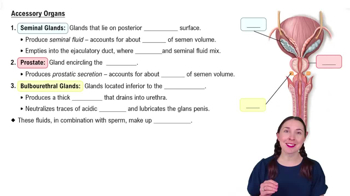
Accessory Organs

Seminal Vesicles

The seminal vesicles secrete a viscous fluid rich in fructose and prostaglandins. Fructose serves as an energy source for sperm, while prostaglandins help stimulate smooth muscle contractions in the female reproductive tract, aiding sperm movement.
Recommended video:
3:21
Accessory Organs

Prostate and Bulbourethral Glands

The prostate gland produces a slightly alkaline fluid that neutralizes acidic vaginal secretions, enhancing sperm survival. The bulbourethral glands secrete a clear mucus that lubricates the urethra and neutralizes residual acidity, facilitating sperm passage during ejaculation.
Recommended video:
Guided course
7:10
Hypothalamus & Pituitary Gland