Ch. 20 The Lymphatic System and Lymphoid Organs and Tissues
Marieb - Human Anatomy & Physiology 7th Edition
Marieb, Hoehn7th EditionHuman Anatomy & PhysiologyISBN: 9780805359091Not the one you use?Change textbook
Chapter 19, Problem 12

A friend tells you that she has tender, swollen 'glands' along the left side of the front of her neck. You notice that she has a bandage on her left cheek that is not fully hiding a large infected cut there. Exactly what are her swollen 'glands,' and how did they become swollen?

Verified step by step guidance
1
Identify the 'glands' mentioned as swollen along the left side of the front of the neck. In anatomy, these are most likely the lymph nodes, which are part of the lymphatic system and act as filters for harmful substances.
Understand the role of lymph nodes: they trap bacteria, viruses, and other foreign particles, and contain immune cells that help fight infection.
Recognize that the infected cut on the left cheek is a source of infection. The lymphatic vessels drain fluid from the cheek area to the nearby lymph nodes in the neck.
Explain that the lymph nodes become swollen and tender because they are actively working to filter out the infection from the cheek wound, causing inflammation and enlargement.
Summarize that the swollen 'glands' are actually lymph nodes responding to the infection in the cheek by increasing immune activity, which leads to their tenderness and swelling.

Verified video answer for a similar problem:

This video solution was recommended by our tutors as helpful for the problem above.
Video duration:
1m
Was this helpful?

Key Concepts

Here are the essential concepts you must grasp in order to answer the question correctly.

Lymph Nodes and Their Function

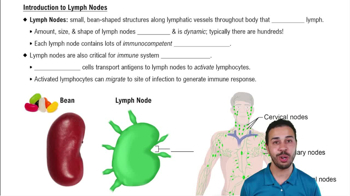
Lymph nodes are small, bean-shaped structures that are part of the lymphatic system. They filter lymph fluid and trap pathogens like bacteria and viruses. When an infection occurs nearby, lymph nodes can become swollen and tender as they produce immune cells to fight the infection.
Recommended video:
5:05
Introduction to Lymph Nodes

Lymphatic Drainage and Regional Infection

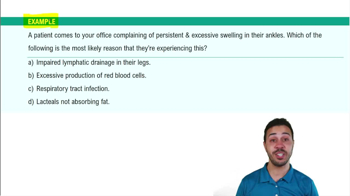
Lymphatic vessels drain fluid from tissues to nearby lymph nodes. Infections in a specific area, such as the cheek, cause the lymph nodes that drain that region—like those along the front of the neck—to become inflamed. This localized swelling indicates the immune system's response to the infection.
Recommended video:
3:32
Introduction to the Lymphatic System Example 2

Signs of Infection and Immune Response

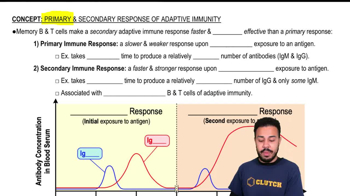
Swollen, tender lymph nodes often signal an active immune response to infection. The presence of a large infected cut on the cheek suggests bacteria entered the tissue, triggering inflammation and immune cell activation in the nearby lymph nodes, causing them to enlarge and become painful.
Recommended video:
6:59
Primary and Secondary Response of Adaptive Immunity