Ch. 26 The Urinary System
Martini - Fundamentals of Anatomy & Physiology 11th Edition
Martini, Nath, Bartholomew11th EditionFundamentals of Anatomy & PhysiologyISBN: 9780136874089Not the one you use?Change textbook
Chapter 25, Problem 5

The distal convoluted tubule is an important site for 
(a) Active secretion of ions
(b) Active secretion of acids and other materials
(c) Selective reabsorption of sodium ions from the tubular fluid
(d) All of these

Verified step by step guidance
1
Step 1: Understand the function of the distal convoluted tubule (DCT) in the nephron, which is a part of the kidney involved in urine formation and regulation of electrolyte balance.
Step 2: Recognize that the DCT plays a role in active secretion, which means moving substances from the blood into the tubular fluid against their concentration gradient, requiring energy.
Step 3: Identify that the DCT actively secretes ions, including hydrogen and potassium ions, which helps regulate acid-base balance and electrolyte levels.
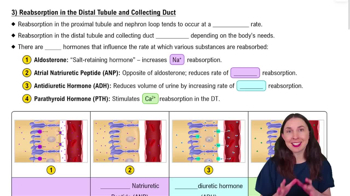
Step 4: Note that the DCT also performs selective reabsorption, particularly of sodium ions (Na\^+), which is controlled by hormones like aldosterone to maintain blood pressure and volume.
Step 5: Conclude that since the DCT is involved in active secretion of ions and acids as well as selective reabsorption of sodium ions, the correct comprehensive answer is that it performs all these functions.

Verified video answer for a similar problem:

This video solution was recommended by our tutors as helpful for the problem above.
Was this helpful?

Key Concepts

Here are the essential concepts you must grasp in order to answer the question correctly.

Distal Convoluted Tubule (DCT) Function

The distal convoluted tubule is a segment of the nephron involved in the fine-tuning of urine composition. It plays a key role in selective reabsorption and secretion processes, helping regulate electrolyte balance, pH, and fluid volume.
Recommended video:
4:24
3) Reabsorption in the Distal Tubule and Collecting Duct

Active Secretion and Reabsorption

Active secretion involves the energy-dependent transport of substances like ions and acids from the blood into the tubular fluid. Similarly, selective reabsorption actively retrieves essential ions such as sodium from the filtrate back into the bloodstream, maintaining homeostasis.
Recommended video:
01:33
Protein Secretion

Regulation of Electrolytes and Acid-Base Balance

The DCT contributes to maintaining electrolyte levels and acid-base balance by secreting acids and reabsorbing sodium ions. This regulation is crucial for controlling blood pressure, pH, and overall fluid balance in the body.
Recommended video:
01:29
Acids and Bases