
Ch. 2 The Chemical Level of Organization
Martini - Fundamentals of Anatomy & Physiology 11th Edition
Martini, Nath, Bartholomew11th EditionFundamentals of Anatomy & PhysiologyISBN: 9780136874089Not the one you use?Change textbook
Chapter 2, Problem 26

Explain the differences among nonpolar covalent bonds, polar covalent bonds, and ionic bonds.

Verified step by step guidance
1
Start by defining a covalent bond: it is a chemical bond where atoms share pairs of electrons to achieve stability.
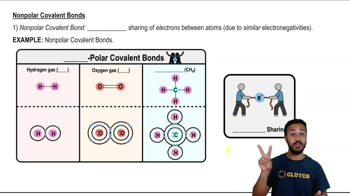
Explain nonpolar covalent bonds: these occur when two atoms share electrons equally because they have similar electronegativities, resulting in no partial charges on the atoms.
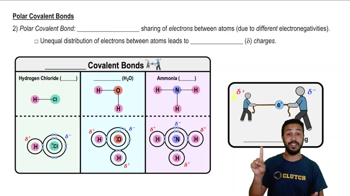
Describe polar covalent bonds: these happen when electrons are shared unequally between two atoms due to a difference in electronegativity, causing partial positive and negative charges (dipoles) on the atoms.
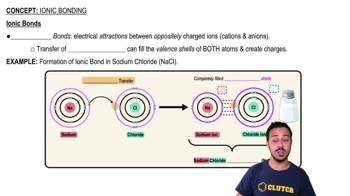
Define ionic bonds: these form when one atom donates one or more electrons to another atom, creating positively charged cations and negatively charged anions that attract each other due to opposite charges.
Summarize the key difference: nonpolar covalent bonds share electrons equally, polar covalent bonds share electrons unequally, and ionic bonds involve the transfer of electrons and electrostatic attraction between ions.

Verified video answer for a similar problem:

This video solution was recommended by our tutors as helpful for the problem above.
Video duration:
3m
Was this helpful?

Key Concepts

Here are the essential concepts you must grasp in order to answer the question correctly.

Nonpolar Covalent Bonds

Nonpolar covalent bonds occur when two atoms share electrons equally due to similar electronegativities. This equal sharing results in a balanced distribution of electrical charge, typically found between identical atoms or atoms with very close electronegativity values.
Recommended video:
05:58
Nonpolar Covalent Bonds

Polar Covalent Bonds

Polar covalent bonds form when electrons are shared unequally between two atoms with different electronegativities. This causes a partial positive charge on one atom and a partial negative charge on the other, creating a dipole moment within the molecule.
Recommended video:
06:59
Polar Covalent Bonds

Ionic Bonds

Ionic bonds arise from the complete transfer of electrons from one atom to another, resulting in oppositely charged ions. These ions attract each other due to electrostatic forces, typically forming between metals and nonmetals with large differences in electronegativity.
Recommended video:
06:07
Ionic Bonds