Ch. 22 The Lymphatic System and Immunity
Martini - Fundamentals of Anatomy & Physiology 11th Edition
Martini, Nath, Bartholomew11th EditionFundamentals of Anatomy & PhysiologyISBN: 9780136874089Not the one you use?Change textbook
Chapter 22, Problem 13

Give a function for each of the following:
(a) Cytotoxic T cells
(b) Helper T cells
(c) Regulatory T cells
(d) Plasma cells
(e) NK cells

Verified step by step guidance
1
Step 1: Understand that each cell type listed plays a distinct role in the immune system, particularly in adaptive and innate immunity. Begin by identifying the primary function of Cytotoxic T cells, which is to directly kill infected or cancerous cells by recognizing antigens presented on MHC class I molecules.
Step 2: For Helper T cells, recognize that their main function is to assist other immune cells by releasing cytokines that stimulate the activity of B cells, Cytotoxic T cells, and macrophages, thus coordinating the immune response.
Step 3: Regulatory T cells function to maintain immune system balance by suppressing excessive immune responses and preventing autoimmune reactions, ensuring that the immune system does not attack the body's own tissues.
Step 4: Plasma cells are differentiated B cells whose primary function is to produce and secrete large quantities of antibodies specific to an antigen, playing a crucial role in humoral immunity.
Step 5: Natural Killer (NK) cells are part of the innate immune system and function to recognize and destroy cells that lack normal MHC class I molecules, such as virus-infected cells or tumor cells, without prior sensitization.

Verified video answer for a similar problem:

This video solution was recommended by our tutors as helpful for the problem above.
Was this helpful?

Key Concepts

Here are the essential concepts you must grasp in order to answer the question correctly.

Types of Immune Cells

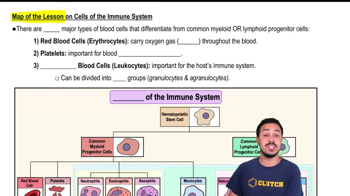
The immune system consists of various specialized cells, each with distinct roles. Understanding the differences between Cytotoxic T cells, Helper T cells, Regulatory T cells, Plasma cells, and Natural Killer (NK) cells is essential to grasp their specific functions in immune defense.
Recommended video:
6:08
Map of the Lesson on Cells of the Immune System

Functions of T Cell Subtypes

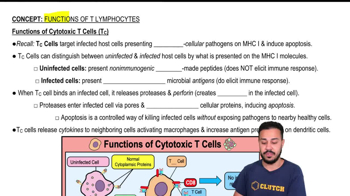
T cells are a critical component of adaptive immunity, with subtypes performing unique roles: Cytotoxic T cells kill infected cells, Helper T cells activate other immune cells, and Regulatory T cells suppress immune responses to maintain balance and prevent autoimmunity.
Recommended video:
6:21
Functions of Cytotoxic T Cells

Role of Plasma Cells and NK Cells

Plasma cells are differentiated B cells that produce antibodies to neutralize pathogens, while Natural Killer (NK) cells are part of the innate immune system, targeting and destroying virus-infected or tumor cells without prior sensitization.
Recommended video:
05:33
Cell Junctions