Name the structures of the female duct system, and describe the important functions of each.
Ch. 16 The Reproductive System

Marieb13th EditionEssentials of Human Anatomy & PhysiologyISBN: 9780135624340Not the one you use?Change textbook
Chapter 16, Problem 22
Why is the term urogenital system more applicable to males than females?
Verified step by step guidance1
Understand the term 'urogenital system': The urogenital system refers to the combination of the urinary system (responsible for excretion of waste products) and the reproductive system (responsible for reproduction). In males, these systems are more anatomically and functionally interconnected than in females.
Examine the male anatomy: In males, the urethra serves a dual purpose—it is part of both the urinary system (carrying urine from the bladder to the outside of the body) and the reproductive system (transporting semen during ejaculation). This shared structure highlights the close relationship between the two systems.
Compare with female anatomy: In females, the urinary and reproductive systems are anatomically distinct. The urethra is solely part of the urinary system, while the reproductive system has separate structures such as the vagina and uterus, which do not overlap with the urinary system.
Consider the functional integration: In males, the prostate gland and seminal vesicles, which are part of the reproductive system, are closely associated with the urethra. This integration further supports the use of the term 'urogenital system' for males.
Conclude the reasoning: Since the male urinary and reproductive systems share structures and functions, the term 'urogenital system' is more applicable to males. In females, the systems are anatomically and functionally separate, making the term less relevant.

Verified video answer for a similar problem:
This video solution was recommended by our tutors as helpful for the problem above.
Video duration:
2mWas this helpful?
Key Concepts
Here are the essential concepts you must grasp in order to answer the question correctly.
Urogenital System Definition
The urogenital system refers to the organs involved in both the urinary and reproductive systems. In males, this system includes structures such as the prostate, seminal vesicles, and penis, which are integral to both urine excretion and reproduction. In females, while the urinary system is similar, the reproductive system is more distinct and separate, leading to different terminologies.
Recommended video:
Introduction to the Reproductive System Example 2
Anatomical Differences
Males and females have significant anatomical differences in their reproductive systems. Males possess a more integrated urogenital system where the urinary and reproductive tracts share common pathways, such as the urethra. In contrast, females have separate pathways for urine and reproductive functions, making the term 'urogenital' less applicable as a combined system.
Recommended video:
Guided course
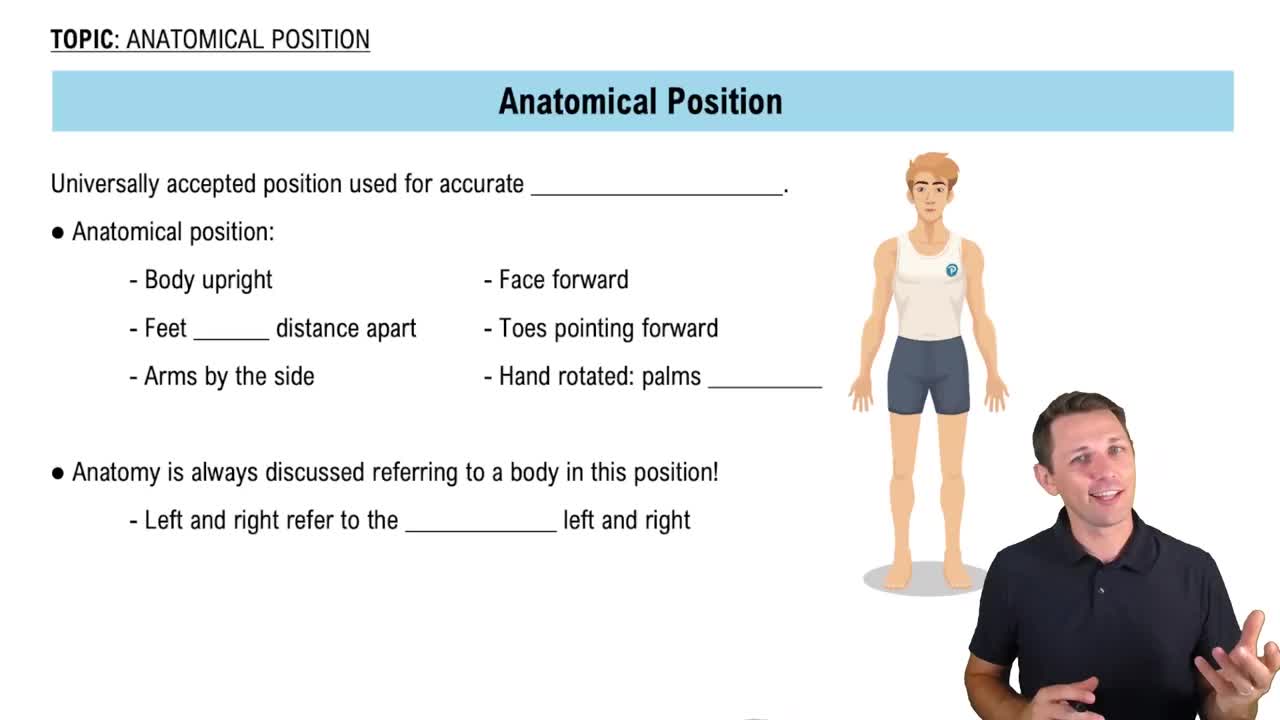
Anatomical Position
Terminology Usage
The term 'urogenital' is often used in medical and biological contexts to describe conditions or studies involving both urinary and reproductive systems. Its application is more common in males due to the shared structures and functions, whereas in females, the distinct separation of these systems leads to the use of more specific terms, such as 'urinary system' and 'reproductive system.'
Recommended video:
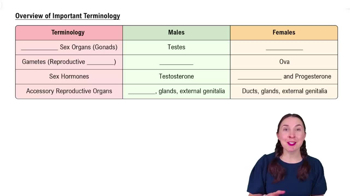
Overview of Important Terminology
Related Practice
Textbook Question
Textbook Question
Name the female gonad, and describe its two major functions.
2
views
Textbook Question
Why are the male gonads not found in the abdominal cavity? Where are they found?
1
views
Textbook Question
Crystal had both her left ovary and her right uterine tube removed surgically at age 17 because of a cyst and a tumor in these organs. Now, at age 32, she remains healthy and is expecting her second child. How could Crystal conceive a child with just one ovary and one uterine tube, separated on opposite sides of the pelvis?
Textbook Question
Given that the uterine tubes are not continuous with the ovaries, how can you explain the fact that not all ovulated 'eggs' end up in the female's peritoneal cavity?
1
views
Textbook Question
What is the function of seminal fluid? Name the three types of glands that help produce it.
2
views