
Ch. 2 The Chemistry of Life
Amerman - Human Anatomy & Physiology 2nd Edition
Amerman2nd EditionHuman Anatomy & PhysiologyISBN: 9780136873822Not the one you use?Change textbook
Chapter 2, Problem 18

Which of the following is not part of a nucleotide?
a. An amino acid
b. A nitrogenous base
c. One or more phosphate groups
d. A sugar

Verified step by step guidance
1
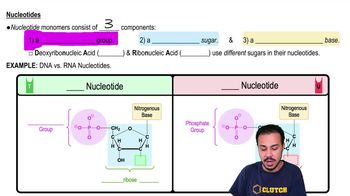
Step 1: Begin by understanding the structure of a nucleotide. A nucleotide is the building block of nucleic acids (DNA and RNA) and consists of three main components: a nitrogenous base, a sugar (pentose), and one or more phosphate groups.
Step 2: Review the options provided in the question. The options are: a) An amino acid, b) A nitrogenous base, c) One or more phosphate groups, and d) A sugar.
Step 3: Recall that amino acids are the building blocks of proteins, not nucleotides. This is a key distinction in molecular biology.
Step 4: Confirm that the other components listed (nitrogenous base, phosphate groups, and sugar) are indeed part of a nucleotide structure.
Step 5: Conclude that the correct answer is the option that does not belong to the nucleotide structure, based on the information reviewed in the previous steps.

Verified video answer for a similar problem:

This video solution was recommended by our tutors as helpful for the problem above.
Was this helpful?

Key Concepts

Here are the essential concepts you must grasp in order to answer the question correctly.

Nucleotide Structure

A nucleotide is the basic building block of nucleic acids, such as DNA and RNA. It consists of three components: a nitrogenous base (adenine, thymine, cytosine, or guanine), a five-carbon sugar (ribose in RNA and deoxyribose in DNA), and one or more phosphate groups. Understanding these components is essential for recognizing the role of nucleotides in genetic information storage and transfer.
Recommended video:
05:35
Nucleotides

Nitrogenous Bases

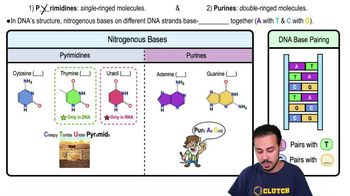
Nitrogenous bases are organic molecules that contain nitrogen and are a key part of nucleotides. They are classified into two categories: purines (adenine and guanine) and pyrimidines (cytosine, thymine, and uracil). These bases pair specifically (A with T or U, and C with G) to form the rungs of the DNA ladder, which is crucial for the structure and function of nucleic acids.
Recommended video:
07:21
5 Nitrogenous Bases

Phosphate Groups

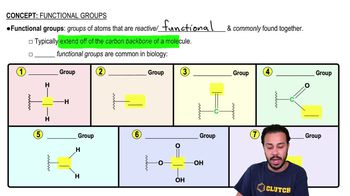
Phosphate groups are essential components of nucleotides, contributing to the backbone of DNA and RNA. They are negatively charged and link nucleotides together through phosphodiester bonds, forming long chains that make up the nucleic acid structure. The presence of one or more phosphate groups is vital for the energy transfer processes in cells, such as ATP synthesis.
Recommended video:
06:04
Functional Groups