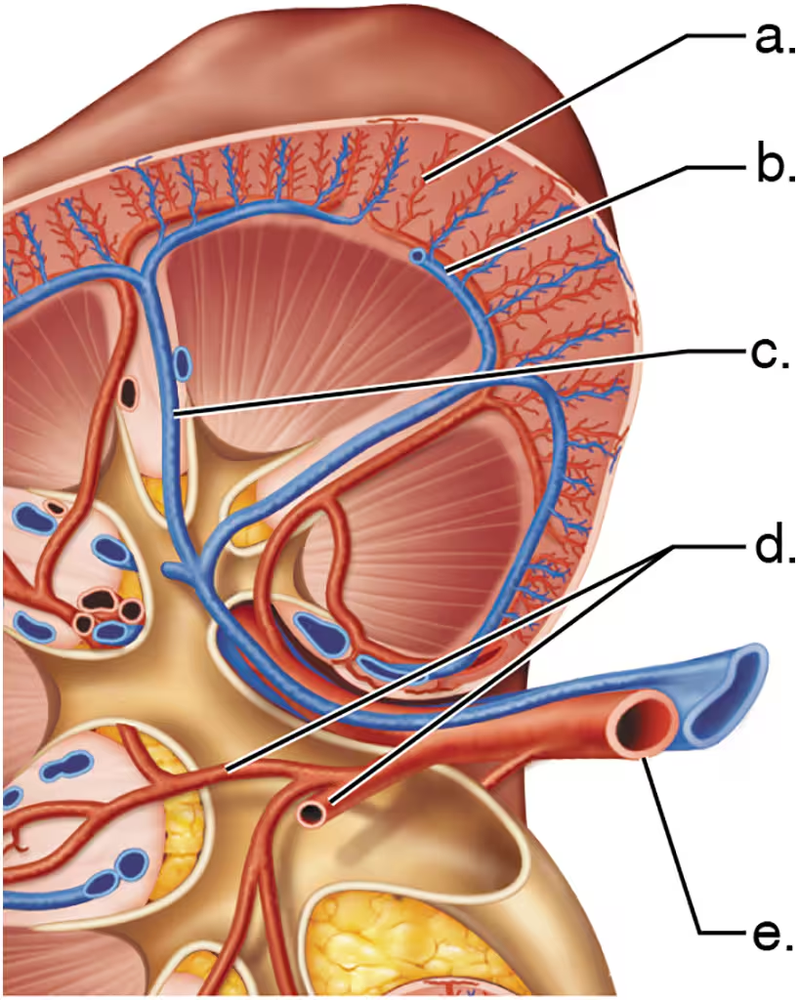
Match each letter from the figure with the correct blood vessel name. Cortical radiate artery
Verified step by step guidance
1
Understand the anatomy of the kidney: The kidney is divided into two main regions—the outer cortex and the inner medulla. Blood supply to the kidney is highly organized to ensure filtration and nutrient delivery.
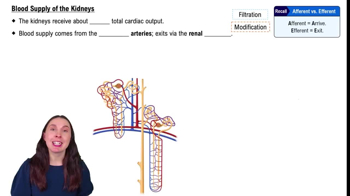
Learn the pathway of blood flow in the kidney: Blood enters the kidney through the renal artery, which branches into smaller arteries, including the segmental arteries, interlobar arteries, arcuate arteries, and finally the cortical radiate arteries.
Identify the role of cortical radiate arteries: These arteries are located in the renal cortex, the outer region of the kidney. They branch off from the arcuate arteries and supply blood to the nephrons, the functional units of the kidney responsible for filtration.
Understand the connection to nephrons: The cortical radiate arteries further branch into afferent arterioles, which deliver blood to the glomeruli within the nephrons for filtration. This is a critical step in urine formation.
Summarize the function: The cortical radiate arteries specifically supply blood to the renal cortex, ensuring that the nephrons in this region receive the necessary blood flow for filtration and other kidney functions.
Verified video answer for a similar problem:
This video solution was recommended by our tutors as helpful for the problem above
Video duration:
3m
Play a video:
0 Comments
Key Concepts
Here are the essential concepts you must grasp in order to answer the question correctly.
Cortical Radiate Arteries
Cortical radiate arteries, also known as interlobular arteries, are small blood vessels that branch off from the arcuate arteries in the kidney. They extend into the renal cortex, supplying oxygenated blood to the renal cortex, which is the outer region of the kidney where filtration occurs.
The renal cortex is the outer layer of the kidney, situated between the renal capsule and the renal medulla. It contains the glomeruli, proximal and distal convoluted tubules, and is crucial for the filtration of blood and the formation of urine. Understanding its structure and function is essential for comprehending how blood supply impacts kidney function.
The blood supply in the kidney is vital for its function, as it provides the necessary oxygen and nutrients for renal tissues. The renal arteries branch into smaller arteries, including the cortical radiate arteries, ensuring that all parts of the kidney receive adequate blood flow for filtration and waste removal. This system is essential for maintaining homeostasis in the body.