More than one choice may apply. Which of the following antibody capabilities causes a transfusion reaction with A or B erythrocyte antigens? a. Neutralization b. Precipitation c. Complement fixation d. Agglutination
Verified step by step guidance
1
Understand the context of the problem: A transfusion reaction occurs when antibodies in the recipient's blood recognize antigens on the donor's erythrocytes (red blood cells) as foreign, leading to an immune response.
Review the antibody capabilities listed in the question: Neutralization, Precipitation, Complement fixation, and Agglutination. Each of these mechanisms has a distinct role in immune defense.
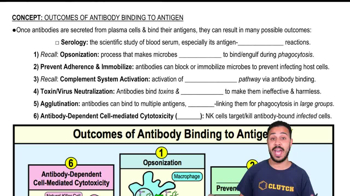
Define Agglutination: Agglutination refers to the clumping of cells or particles caused by antibodies binding to antigens on the surface of erythrocytes. This is a key mechanism in transfusion reactions, as antibodies bind to A or B antigens and cause clumping of red blood cells.
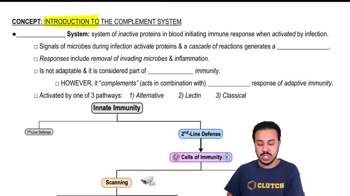
Define Complement fixation: Complement fixation involves antibodies activating the complement system, which can lead to cell lysis (destruction of the cell membrane). This mechanism can also contribute to transfusion reactions by destroying incompatible erythrocytes.
Eliminate Neutralization and Precipitation: Neutralization involves antibodies blocking the activity of pathogens or toxins, which is unrelated to transfusion reactions. Precipitation involves antibodies binding to soluble antigens to form insoluble complexes, which is also not directly relevant to transfusion reactions.
Verified video answer for a similar problem:
This video solution was recommended by our tutors as helpful for the problem above
Video duration:
1m
Play a video:
0 Comments
Key Concepts
Here are the essential concepts you must grasp in order to answer the question correctly.
Antibody Function
Antibodies are proteins produced by the immune system that recognize and bind to specific antigens, such as those found on the surface of erythrocytes (red blood cells). Their primary functions include neutralization of pathogens, agglutination of cells, and activation of the complement system, which can lead to cell lysis.
Agglutination is the process by which antibodies bind to multiple antigens on the surface of cells, causing them to clump together. This is a critical mechanism in transfusion reactions, as antibodies against A or B antigens can agglutinate erythrocytes that possess these antigens, leading to potentially severe immune responses.
Complement fixation refers to the process where antibodies bound to antigens activate the complement system, a series of proteins that enhance the immune response. This can lead to the lysis of cells, including erythrocytes in transfusion reactions, but is distinct from agglutination, which is primarily responsible for the clumping of cells.