Mark the following statements as true or false. If a statement is false, correct it to make a true statement. The resting membrane potential refers to the voltage difference across the membranes of excitable cells at rest.
Verified step by step guidance
1
Understand the concept of resting membrane potential: The resting membrane potential is the electrical charge difference across the plasma membrane of a cell when it is not actively sending signals. This is typically due to the distribution of ions like sodium (Na⁺), potassium (K⁺), and chloride (Cl⁻) across the membrane.
Analyze the statement: 'The resting membrane potential refers to the voltage difference across the membranes of excitable cells at rest.'
Determine if the statement is true or false: The statement is true because the resting membrane potential indeed refers to the voltage difference across the membrane of excitable cells (like neurons and muscle cells) when they are not actively transmitting signals.
If the statement were false, you would need to correct it. For example, if the statement incorrectly described the resting membrane potential as occurring during active signaling, you would correct it to specify that it occurs when the cell is at rest.
Conclude that no correction is needed in this case, as the statement is accurate and aligns with the definition of resting membrane potential.
Verified video answer for a similar problem:
This video solution was recommended by our tutors as helpful for the problem above
Play a video:
0 Comments
Key Concepts
Here are the essential concepts you must grasp in order to answer the question correctly.
Resting Membrane Potential
The resting membrane potential is the electrical potential difference across the plasma membrane of a cell when it is not actively sending signals. Typically measured in millivolts (mV), this potential is primarily determined by the distribution of ions, particularly sodium (Na+) and potassium (K+), across the membrane. In excitable cells, such as neurons and muscle cells, the resting membrane potential is crucial for the generation of action potentials.
Excitable cells are specialized cells, such as neurons and muscle fibers, that can rapidly change their membrane potential in response to stimuli. This ability allows them to conduct electrical signals, which is essential for processes like muscle contraction and nerve impulse transmission. The resting membrane potential in these cells is vital for maintaining their excitability and readiness to respond to stimuli.
Voltage difference, or electrical potential difference, refers to the difference in electric charge between two points, which in the context of cells, is measured across the cell membrane. This difference is crucial for the function of excitable cells, as it influences the movement of ions in and out of the cell, thereby affecting cellular activities such as signaling and contraction. Understanding this concept is key to grasping how cells communicate and respond to their environment.

 Verified step by step guidance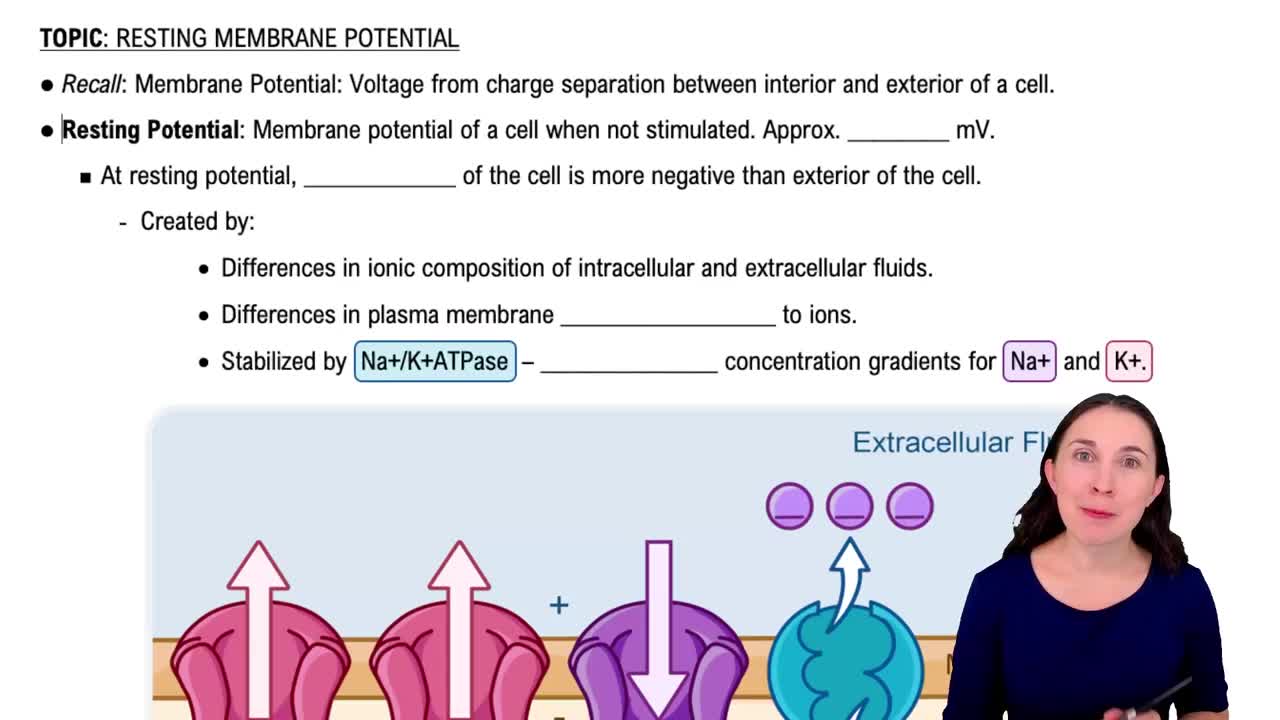
 07:53
07:53