Ch. 29 Heredity

Marieb, Hoehn11th EditionHuman Anatomy & PhysiologyISBN: 9780136874034
Not the one you use?Change textbookSelect a different textbook
Table of contents
- Ch. 1 The Human Body: An Orientation24
- Ch. 2 Chemistry Comes Alive25
- Ch. 3 Cells: The Living Units21
- Ch. 4 Tissue: The Living Fabric20
- Ch. 5 The Integumentary System11
- Ch. 6 Bones and Skeletal Tissues19
- Ch. 7 The Skeleton14
- Ch. 8 Joints7
- Ch. 9 Muscles and Muscle Tissue26
- Ch. 10 The Muscular System26
- Ch. 11 Fundamentals of the Nervous System and Nervous Tissue19
- Ch. 12 The Central Nervous System26
- Ch. 13 The Peripheral Nervous System and Reflex Activity32
- Ch. 14 The Autonomic Nervous System19
- Ch. 15 The Special Senses26
- Ch. 16 The Endocrine System23
- Ch. 17 Blood25
- Ch. 18 The Cardiovascular System: The Heart24
- Ch. 19 The Cardiovascular System: Blood Vessels27
- Ch. 20 The Lymphatic System and Lymphoid Organs and Tissues14
- Ch. 21 The Immune System: Innate and Adaptive Body Defenses27
- Ch. 22 The Respiratory System21
- Ch. 23 The Digestive System31
- Ch. 24 Nutrition, Metabolism, and Energy Balance26
- Ch. 25 The Urinary System26
- Ch. 26 Fluid, Electrolyte, and Acid-Base Balance24
- Ch. 27 The Reproductive System24
- Ch. 28 Pregnancy and Human Development25
- Ch. 29 Heredity11
Marieb, Hoehn11th EditionHuman Anatomy & PhysiologyISBN: 9780136874034Not the one you use?Change textbook

Chapter 29, Problem 9
The Browns are both carriers of the recessive allele that causes the metabolic disorder called phenylketonuria. What is the probability of each of the following occurring?
(a) All three children will have the disorder.
(b) None of their three children will have the disorder.
(c) One or more of their children will have the disorder.
(d) At least one of their children will be phenotypically normal.
 Verified step by step guidance
1
Step 1: Understand the genetic background. Since both parents are carriers of the recessive allele for phenylketonuria (PKU), each child has a 1/4 chance of inheriting two recessive alleles and thus having the disorder, a 1/2 chance of being a carrier (heterozygous), and a 1/4 chance of inheriting two dominant alleles (normal). The key probabilities for each child are: affected (1/4), carrier (1/2), and normal (1/4).
Step 2: For part (a), calculate the probability that all three children have the disorder. Since each child’s genotype is independent, multiply the probability of one child having the disorder by itself three times: \(\left(\frac{1}{4}\right)^3\).
Step 3: For part (b), calculate the probability that none of the three children have the disorder. This means each child is either a carrier or normal, so the probability for one child not having the disorder is \(1 - \frac{1}{4} = \frac{3}{4}\). Then raise this to the power of three for all children: \(\left(\frac{3}{4}\right)^3\).
Step 4: For part (c), find the probability that one or more children have the disorder. This is the complement of none having the disorder, so subtract the result from part (b) from 1: \(1 - \left(\frac{3}{4}\right)^3\).
Step 5: For part (d), find the probability that at least one child is phenotypically normal (not a carrier or affected). The probability that one child is phenotypically normal is \(\frac{1}{4}\). The complement is that none are normal, so calculate the probability that all three children are either carriers or affected: \(\left(1 - \frac{1}{4}\right)^3 = \left(\frac{3}{4}\right)^3\). Then subtract this from 1 to get the probability that at least one child is normal: \(1 - \left(\frac{3}{4}\right)^3\).
Key Concepts
Here are the essential concepts you must grasp in order to answer the question correctly.
Autosomal Recessive Inheritance
Phenylketonuria (PKU) is inherited in an autosomal recessive pattern, meaning a child must inherit two copies of the recessive allele (one from each parent) to express the disorder. Carriers have one recessive and one dominant allele and typically do not show symptoms but can pass the allele to offspring.
Recommended video:
Guided course
 01:02
01:02
Autosomal Inheritance
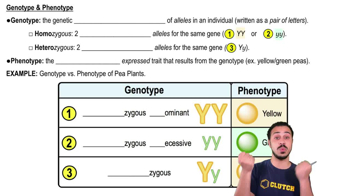
Probability of Genotypes in Offspring
When both parents are carriers, each child has a 25% chance of having the disorder (homozygous recessive), 50% chance of being a carrier (heterozygous), and 25% chance of being homozygous dominant (normal). These probabilities apply independently to each child.
Recommended video:
Guided course
 06:36
06:36Genotype & Phenotype
Calculating Combined Probabilities for Multiple Children
To find probabilities for multiple children, multiply individual probabilities for independent events. For example, the chance all three children have the disorder is (1/4)^3, while the chance none have it is (3/4)^3. Complement rules help calculate probabilities like 'one or more' occurrences.
Recommended video:
Guided course
 3:11
3:11B cell Activation by T Independent Antigens
Related Practice