Ch. 12 The Lymphatic System and Body Defenses
Marieb - Essentials of Human Anatomy & Physiology 13th Edition
Marieb13th EditionEssentials of Human Anatomy & PhysiologyISBN: 9780135624340Not the one you use?Change textbook
Chapter 12, Problem 13

The main cellular target of the HIV virus that causes AIDS is
a. Helper T cells
b. Cytotoxic T cells
c. Macrophages
d. B cells

Verified step by step guidance
1
Understand the role of the immune system's cells: Helper T cells (CD4+), Cytotoxic T cells (CD8+), Macrophages, and B cells. Each has a specific function in immunity.
Recall that HIV primarily targets cells with CD4 receptors, which are found on Helper T cells. These cells are crucial for coordinating the immune response.
Learn that HIV binds to the CD4 receptor on Helper T cells using its glycoprotein (gp120), allowing the virus to enter and infect these cells.
Understand the consequences of HIV targeting Helper T cells: It leads to a weakened immune system, as these cells are essential for activating other immune cells like Cytotoxic T cells and B cells.
Conclude that the main cellular target of HIV is Helper T cells, as they are the primary site of infection and play a central role in the progression of AIDS.

Verified video answer for a similar problem:

This video solution was recommended by our tutors as helpful for the problem above.
Video duration:
4m
Was this helpful?

Key Concepts

Here are the essential concepts you must grasp in order to answer the question correctly.

HIV and its Mechanism of Infection

HIV (Human Immunodeficiency Virus) primarily targets the immune system, specifically the CD4+ T cells, also known as Helper T cells. These cells play a crucial role in orchestrating the immune response. By infecting and destroying these cells, HIV undermines the body's ability to fight off infections and diseases, leading to AIDS (Acquired Immunodeficiency Syndrome).
Recommended video:
2:38
Step 1: Tissue Damage & Infection

Helper T Cells

Helper T cells are a subset of T lymphocytes that are essential for the adaptive immune response. They assist other immune cells by releasing cytokines, which help activate B cells to produce antibodies and cytotoxic T cells to kill infected cells. The depletion of Helper T cells by HIV is a key factor in the progression to AIDS, as it severely compromises the immune system.
Recommended video:
4:27
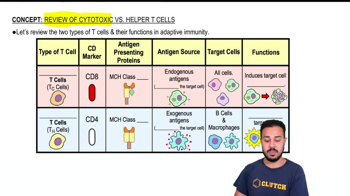
Review of Cytotoxic vs Helper T Cells

Immune System Components

The immune system consists of various cells and organs that work together to defend the body against pathogens. Key components include T cells (both Helper and Cytotoxic), B cells, and macrophages. Each plays a distinct role: B cells produce antibodies, Cytotoxic T cells kill infected cells, and macrophages engulf pathogens. Understanding these components is vital for grasping how HIV affects immune function.
Recommended video:
Guided course
5:04
Optic Components