Which four ganglia serve as origins for postganglionic fibers involved in control of visceral structures in the head?
Verified step by step guidance
1
Step 1: Understand the role of ganglia in the autonomic nervous system. Ganglia are clusters of neuron cell bodies where preganglionic fibers synapse with postganglionic neurons. In the head, specific ganglia serve as relay points for postganglionic fibers controlling visceral structures.
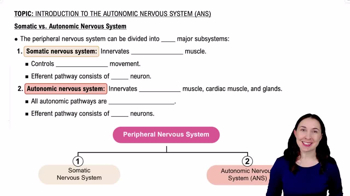
Step 2: Recall that the autonomic nervous system is divided into sympathetic and parasympathetic divisions, each with distinct ganglia. The question focuses on ganglia that give rise to postganglionic fibers controlling visceral structures in the head, which are primarily parasympathetic ganglia.
Step 3: Identify the four main parasympathetic ganglia in the head: the ciliary ganglion, pterygopalatine ganglion, submandibular ganglion, and otic ganglion. Each of these ganglia is associated with specific cranial nerves and target organs.
Step 4: Review the functions and connections of each ganglion: the ciliary ganglion controls the eye muscles; the pterygopalatine ganglion controls lacrimal glands and nasal mucosa; the submandibular ganglion controls salivary glands; and the otic ganglion controls the parotid salivary gland.
Step 5: Summarize that these four ganglia serve as origins for postganglionic fibers that innervate various visceral structures in the head, completing the pathway from preganglionic neurons to target tissues.
Verified video answer for a similar problem:
This video solution was recommended by our tutors as helpful for the problem above
Play a video:
0 Comments
Key Concepts
Here are the essential concepts you must grasp in order to answer the question correctly.
Autonomic Nervous System (ANS) Ganglia
Ganglia in the ANS are clusters of nerve cell bodies where preganglionic neurons synapse with postganglionic neurons. These ganglia serve as relay points for transmitting nerve signals to target organs, especially in controlling involuntary functions like those of visceral structures.
Postganglionic fibers are nerve fibers that extend from autonomic ganglia to the target organs. They carry signals that regulate functions such as gland secretion, blood vessel constriction, and muscle control in visceral structures, particularly in the head region.
The four main cranial ganglia serving as origins for postganglionic fibers controlling head viscera are the ciliary, pterygopalatine, submandibular, and otic ganglia. Each is associated with specific cranial nerves and controls different visceral functions like pupil constriction, lacrimation, salivation, and blood flow.