Plastids that are surrounded by more than two membranes are evidence of
a. evolution from mitochondria.
b. fusion of plastids.
c. origin of the plastids from archaea.
d. secondary endosymbiosis.
Verified step by step guidance
1
Understand the concept of plastids and their role in cells. Plastids are organelles found in the cells of plants and algae, primarily involved in photosynthesis and storage of products like starch.
Recognize that most plastids, like chloroplasts, are surrounded by two membranes, which is typical for organelles that originated from primary endosymbiosis.
Learn about secondary endosymbiosis, a process where a eukaryotic cell engulfs another eukaryotic cell that already contains plastids, leading to plastids with more than two membranes.
Consider the options given: evolution from mitochondria, fusion of plastids, origin from archaea, and secondary endosymbiosis. Evaluate which process is known to result in plastids with more than two membranes.
Conclude that secondary endosymbiosis is the process that typically results in plastids being surrounded by more than two membranes, as it involves the engulfment of a eukaryotic cell that already contains plastids.
Verified video answer for a similar problem:
This video solution was recommended by our tutors as helpful for the problem above.
Video duration:
1m
Play a video:
0 Comments
Key Concepts
Here are the essential concepts you must grasp in order to answer the question correctly.
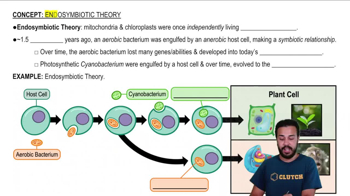
Endosymbiotic Theory
The endosymbiotic theory posits that certain organelles, such as mitochondria and plastids, originated from free-living prokaryotic organisms that were engulfed by ancestral eukaryotic cells. This theory explains how these organelles have their own DNA and double membranes, supporting the idea of a symbiotic relationship that evolved over time.
Secondary endosymbiosis refers to the process where a eukaryotic cell engulfs another eukaryotic cell that has already undergone primary endosymbiosis. This results in organelles, like plastids, that are surrounded by more than two membranes, indicating a complex evolutionary history involving multiple layers of symbiotic relationships.
Plastids are a group of organelles found in plant and algal cells, including chloroplasts, chromoplasts, and leucoplasts. Their diversity and the presence of multiple membranes can provide insights into their evolutionary origins, particularly in relation to secondary endosymbiosis, where different types of plastids may have evolved from various ancestral lineages.

 1:02 minutes
 Verified step by step guidance
 07:29
07:29