Ch. 4 The Tissue Level of Organization
Martini - Fundamentals of Anatomy & Physiology 11th Edition
Martini, Nath, Bartholomew11th EditionFundamentals of Anatomy & PhysiologyISBN: 9780136874089Not the one you use?Change textbook
Chapter 4, Problem 4

A type of cell junction common in cardiac and smooth muscle tissues is the
(a) Hemidesmosome
(b) Basal junction
(c) Tight junction
(d) Gap junction

Verified step by step guidance
1
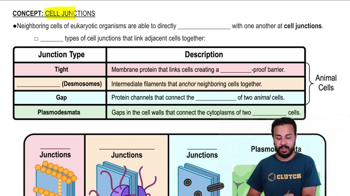
Step 1: Understand the types of cell junctions and their functions. Hemidesmosomes anchor cells to the basement membrane, basal junction is not a standard term for cell junctions, tight junctions create a seal between cells to prevent leakage, and gap junctions allow direct communication between cells.
Step 2: Recall that cardiac and smooth muscle tissues require coordinated contraction, which depends on rapid electrical and chemical communication between cells.
Step 3: Identify which junction type facilitates this communication. Gap junctions form channels that enable ions and small molecules to pass directly between adjacent cells, allowing synchronized contraction.
Step 4: Recognize that hemidesmosomes and tight junctions do not support this type of intercellular communication, and basal junction is not relevant here.
Step 5: Conclude that the correct answer is the cell junction type that supports communication in cardiac and smooth muscle tissues, which is the gap junction.

Verified video answer for a similar problem:

This video solution was recommended by our tutors as helpful for the problem above.
Video duration:
1m
Was this helpful?

Key Concepts

Here are the essential concepts you must grasp in order to answer the question correctly.

Cell Junctions

Cell junctions are specialized structures that connect adjacent cells, allowing them to communicate and maintain tissue integrity. Different types of junctions serve distinct functions such as adhesion, communication, or barrier formation.
Recommended video:
05:33
Cell Junctions

Gap Junctions

Gap junctions are channels that directly connect the cytoplasm of neighboring cells, enabling the exchange of ions and small molecules. They are crucial in cardiac and smooth muscle tissues for synchronized contraction by allowing electrical signals to pass rapidly.
Recommended video:
05:33
Cell Junctions

Muscle Tissue Types

Cardiac and smooth muscles are involuntary muscle types with unique structural features. Both rely on specialized junctions like gap junctions to coordinate contractions, unlike skeletal muscle which uses different mechanisms for contraction control.
Recommended video:
Guided course
00:36
3 Types of Muscle Tissue