
Ch. 3 The Cell
Amerman - Human Anatomy & Physiology 2nd Edition
Amerman2nd EditionHuman Anatomy & PhysiologyISBN: 9780136873822Not the one you use?Change textbook
Chapter 3, Problem 5e

Mark the following statements about the plasma membrane as true or false. If a statement is false, correct it to make a true statement.
The overall structure of the plasma membrane is a mosaic with the components locked tightly in place.

Verified step by step guidance
1
Understand the structure of the plasma membrane: The plasma membrane is described by the fluid mosaic model, which means it is composed of a flexible lipid bilayer with embedded proteins, cholesterol, and carbohydrates. The components are not locked in place but are free to move laterally within the layer.
Evaluate the statement: 'The overall structure of the plasma membrane is a mosaic with the components locked tightly in place.' This statement is partially correct in describing the 'mosaic' nature but incorrect in stating that the components are 'locked tightly in place.'
Correct the false part of the statement: Replace 'locked tightly in place' with 'able to move laterally within the lipid bilayer.'
The corrected statement should read: 'The overall structure of the plasma membrane is a mosaic with the components able to move laterally within the lipid bilayer.'
Review the fluid mosaic model to reinforce understanding: The flexibility of the plasma membrane is crucial for its functions, such as cell signaling, transport, and maintaining homeostasis.

Verified video answer for a similar problem:

This video solution was recommended by our tutors as helpful for the problem above.
Was this helpful?

Key Concepts

Here are the essential concepts you must grasp in order to answer the question correctly.

Fluid Mosaic Model

The fluid mosaic model describes the plasma membrane as a dynamic structure where various components, such as lipids and proteins, are not rigidly fixed but rather float freely within or on the lipid bilayer. This model emphasizes the flexibility and diversity of the membrane, allowing for various functions such as transport and communication.
Recommended video:
Guided course
3:33
Serous Cavity and Fluid

Phospholipid Bilayer

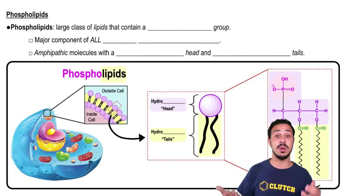
The plasma membrane is primarily composed of a phospholipid bilayer, where hydrophilic (water-attracting) heads face outward towards the aqueous environment, while hydrophobic (water-repelling) tails face inward. This arrangement creates a semi-permeable barrier that regulates the movement of substances in and out of the cell.
Recommended video:
04:05
Phospholipids

Membrane Proteins

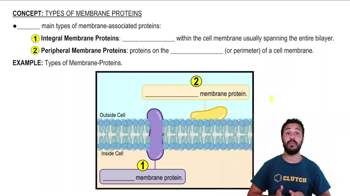
Membrane proteins are integral and peripheral proteins embedded in or associated with the plasma membrane. They play crucial roles in various functions, including transport, signaling, and maintaining the cell's structure. Their presence contributes to the 'mosaic' aspect of the fluid mosaic model, highlighting the diverse functions of the membrane.
Recommended video:
03:05
Types of Membrane Proteins
Related Practice
Textbook Question

Match the term with its appropriate definition. 

Osmosis    

Secondary active transport    

Exocytosis    

Phagocytosis    

Simple diffusion    

Primary active transport    

Pinocytosis    

Facilitated diffusion

a. Type of endocytosis in which a large particle is ingested

b. Transport across the plasma membrane against the concentration gradient via direct use of energy from ATP

c. Passive movement of solute across the plasma membrane

d. Movement of solvent from a solution of lower solute concentration to a solution of higher solute concentration

e. Passive movement of solute across the plasma membrane via a channel or carrier protein

f. Type of endocytosis in which ECF is brought into the cell in a protein-coated pit

g. Release of large substances from the cell through a vesicle

h. Transport of a substance across the plasma membrane against its concentration gradient using the energy from the 'downhill' movement of another substance

1
views
Textbook Question

Mark the following statements about the plasma membrane as true or false. If a statement is false, correct it to make a true statement.

Membrane proteins often function as channels or carriers.

4
views
Textbook Question

Mark the following statements about the plasma membrane as true or false. If a statement is false, correct it to make a true statement.

Membrane cholesterol is vital for cell-cell recognition.

1
views
Textbook Question

A hypotonic solution will cause water to move ________the cell, and the cell will ______.

A hypertonic solution will cause water to move ______the cell, and the cell will ________.

1
views
Textbook Question

Mark the following statements about the plasma membrane as true or false. If a statement is false, correct it to make a true statement.

Cholesterol provides the plasma membrane with stability in the face of changing ion concentrations.

Textbook Question

What is the primary difference between active transport processes and passive transport processes?

2
views