Ch. 22 The Digestive System
Amerman - Human Anatomy & Physiology 2nd Edition
Amerman2nd EditionHuman Anatomy & PhysiologyISBN: 9780136873822Not the one you use?Change textbook
Chapter 22, Problem L3.1c

Mr. Williams presents to your clinic with a complaint of abdominal pain in the right upper quadrant. He says that the pain worsens when he eats, particularly when he eats fatty meals. He has noticed that his stool has been an unusual clay color recently. You perform an ultrasound of his abdomen and find that gallstones are blocking his common bile duct, preventing bile from entering the duodenum.
Explain why his feces have become a clay color instead of a normal brown color.

Verified step by step guidance
1
Understand the role of bile in digestion: Bile is produced by the liver and stored in the gallbladder. It contains bile pigments, such as bilirubin, which are derived from the breakdown of hemoglobin in red blood cells. Bilirubin is responsible for giving feces their normal brown color after being metabolized in the intestines.
Identify the function of the common bile duct: The common bile duct is the pathway through which bile travels from the liver and gallbladder to the duodenum (the first part of the small intestine). This allows bile to mix with food and aid in the digestion of fats.
Recognize the impact of gallstones blocking the common bile duct: When gallstones obstruct the common bile duct, bile cannot flow into the duodenum. This prevents bile pigments, including bilirubin, from being excreted into the intestines.
Explain the absence of bilirubin in the intestines: Without bilirubin entering the intestines, it cannot be metabolized into stercobilin, the compound that gives feces their brown color. As a result, the feces take on a pale or clay-like appearance.
Connect the symptoms to the diagnosis: The clay-colored stool is a direct result of the bile duct obstruction caused by gallstones. This symptom, along with the abdominal pain and worsening symptoms after fatty meals, is consistent with a diagnosis of gallstone-related bile duct blockage.

Verified video answer for a similar problem:

This video solution was recommended by our tutors as helpful for the problem above.
Was this helpful?

Key Concepts

Here are the essential concepts you must grasp in order to answer the question correctly.

Bile Production and Function

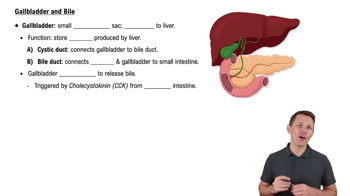
Bile is a digestive fluid produced by the liver and stored in the gallbladder, essential for the emulsification and digestion of fats. It contains bile salts, bilirubin, and cholesterol. When food, especially fatty meals, enters the duodenum, bile is released to aid in digestion. If bile flow is obstructed, as in Mr. Williams' case, the digestion of fats is impaired, leading to changes in stool color.
Recommended video:
Guided course
6:54
Gallbladder and Bile

Bilirubin Metabolism

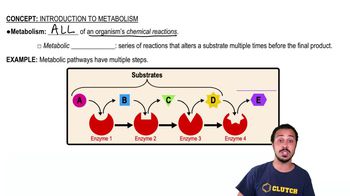
Bilirubin is a byproduct of the breakdown of red blood cells and is normally processed by the liver, where it is conjugated and excreted into bile. This conjugated bilirubin contributes to the brown color of normal feces. When bile flow is obstructed, bilirubin cannot reach the intestines, leading to a decrease in its presence in the stool, which can result in a clay-colored appearance.
Recommended video:
02:17
Introduction to Metabolism

Effects of Obstruction in the Biliary System

Obstruction in the biliary system, such as from gallstones blocking the common bile duct, prevents bile from entering the duodenum. This obstruction not only affects fat digestion but also alters the normal color of feces. Without bile, the stool lacks the pigments that give it a brown color, resulting in a pale or clay-colored appearance, as seen in Mr. Williams' case.
Recommended video:
1:32
Effects of the Complement System
Related Practice
Textbook Question

A surgical procedure known as gastric bypass involves removing all or part of the stomach.

How would stomach removal affect absorption of vitamin B12? Explain.

1
views

Textbook Question

Mr. Williams presents to your clinic with a complaint of abdominal pain in the right upper quadrant. He says that the pain worsens when he eats, particularly when he eats fatty meals. He has noticed that his stool has been an unusual clay color recently. You perform an ultrasound of his abdomen and find that gallstones are blocking his common bile duct, preventing bile from entering the duodenum.

You test Mr. Williams's stool and find high amounts of undigested fats. Explain this finding.

2
views
Textbook Question

Mark the following statements as true or false. If a statement is false, correct it to make a true statement.

The muscularis externa of most of the alimentary canal consists of inner circular and outer longitudinal layers of smooth muscle.

2
views
Textbook Question

Individuals experiencing prolonged vomiting lose a great deal of hydrochloric acid with the vomitus. Predict the effect this loss of acid will have on the pH of the blood. How will the respiratory system respond to the change in pH?

1
views
Textbook Question

Mark the following statements as true or false. If a statement is false, correct it to make a true statement.

The mucosa of the esophagus, pharynx, and oral cavity contains simple squamous epithelium to protect it from abrasion.

1
views
Textbook Question

Mark the following statements as true or false. If a statement is false, correct it to make a true statement.

The mucosa from the stomach to the anus consists of an inner layer of stratified columnar epithelium.

1
views