By what three major transport mechanisms do substances get into and out of cells?
Verified step by step guidance
1
Identify the three major transport mechanisms by which substances move into and out of cells: diffusion, facilitated diffusion, and active transport.
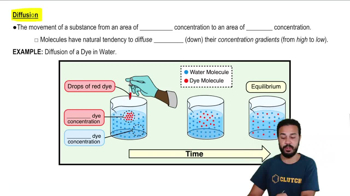
Explain diffusion as the movement of molecules from an area of higher concentration to an area of lower concentration, without the use of energy.
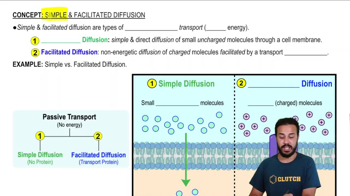
Describe facilitated diffusion as the process where molecules move down their concentration gradient through specific transport proteins in the cell membrane, also without energy expenditure.
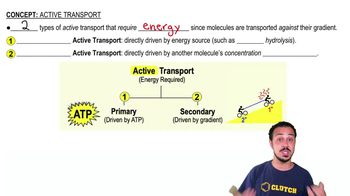
Define active transport as the movement of substances against their concentration gradient, requiring energy in the form of ATP and involving carrier proteins.
Summarize that these mechanisms allow cells to regulate the internal environment by controlling the entry and exit of various substances essential for cellular function.
Verified video answer for a similar problem:
This video solution was recommended by our tutors as helpful for the problem above
Video duration:
2m
Play a video:
0 Comments
Key Concepts
Here are the essential concepts you must grasp in order to answer the question correctly.
Diffusion
Diffusion is the passive movement of molecules from an area of higher concentration to an area of lower concentration. It does not require energy and allows substances like oxygen and carbon dioxide to cross cell membranes efficiently.
Facilitated diffusion is a passive transport process where specific carrier proteins or channels help move molecules across the cell membrane down their concentration gradient. This mechanism is essential for substances that cannot diffuse freely, such as glucose and ions.
Active transport involves the movement of substances against their concentration gradient using energy, usually from ATP. Transport proteins like pumps enable cells to uptake nutrients or expel waste even when concentrations are unfavorable.