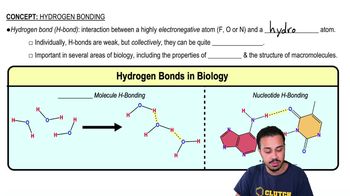
In agricultural areas, farmers pay close attention to the weather forecast. Right before a predicted overnight freeze, farmers spray water on crops to protect the plants. Use the properties of water to explain how this method works. Be sure to mention why hydrogen bonds are responsible for this phenomenon.
Verified step by step guidance
1
Identify the unique properties of water, focusing on its high specific heat capacity and the role of hydrogen bonds.
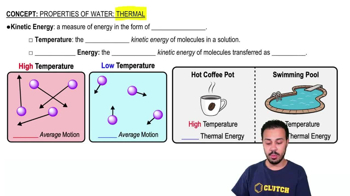
Explain how water's high specific heat capacity allows it to absorb and release heat slowly, which helps moderate temperature changes.
Discuss the formation of hydrogen bonds between water molecules and how these bonds require energy to break, thus releasing heat when water freezes.
Describe how spraying water on crops before a freeze can create a protective layer of ice, which releases latent heat as it forms, helping to keep the plant tissues from freezing.
Conclude by emphasizing the role of hydrogen bonds in maintaining the temperature around the plants, preventing damage from the cold.
Verified video answer for a similar problem:
This video solution was recommended by our tutors as helpful for the problem above
Video duration:
2m
Play a video:
0 Comments
Key Concepts
Here are the essential concepts you must grasp in order to answer the question correctly.
Properties of Water
Water has unique properties, including high specific heat, cohesion, and the ability to exist in three states. These properties arise from its molecular structure and hydrogen bonding, which allow water to absorb and release heat without significant temperature changes. This is crucial for agricultural practices, as it helps regulate temperature around crops during cold weather.
Hydrogen bonds are weak attractions between the hydrogen atom of one water molecule and the oxygen atom of another. These bonds are responsible for water's high specific heat and its ability to release heat slowly. When farmers spray water on crops before a freeze, the water releases heat as it freezes, providing a protective layer that helps maintain the temperature of the plants.
Freezing point depression occurs when a solute (in this case, water) lowers the freezing point of a solution. When water is sprayed on crops, it forms a layer of ice that releases latent heat as it freezes, which can help keep the temperature of the plants above the freezing point. This phenomenon is essential for protecting crops from frost damage during cold nights.