Which statement is true of all atoms that are anions?a. The atom has more electrons than protons.b. The atom has more protons than electrons.c. The atom has fewer protons than does a neutral atom of the same element.d. The atom has more neutrons than protons.
Verified step by step guidance
1
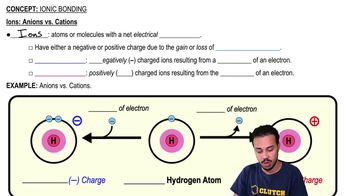
Step 1: Understand the definition of an anion. An anion is an atom or molecule that has gained one or more electrons, resulting in a negative charge.
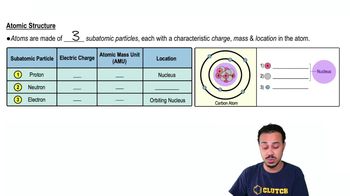
Step 2: Recall that the charge of an atom is determined by the balance between protons (positively charged) and electrons (negatively charged).
Step 3: Analyze each option: (a) More electrons than protons, (b) More protons than electrons, (c) Fewer protons than a neutral atom, (d) More neutrons than protons.
Step 4: Consider the charge of an anion. Since anions are negatively charged, they must have more electrons than protons.
Step 5: Conclude that the correct statement about anions is that they have more electrons than protons, which corresponds to option (a).
Verified video answer for a similar problem:
This video solution was recommended by our tutors as helpful for the problem above
Video duration:
2m
Play a video:
0 Comments
Key Concepts
Here are the essential concepts you must grasp in order to answer the question correctly.
Anions
Anions are negatively charged ions formed when an atom gains one or more electrons. This gain of electrons results in an excess of negative charge compared to the number of protons, which are positively charged. Understanding the formation of anions is crucial for answering questions about atomic charge and electron configuration.
Protons are positively charged particles found in the nucleus of an atom, while electrons are negatively charged particles that orbit the nucleus. The balance between protons and electrons determines the overall charge of an atom. In the case of anions, there are more electrons than protons, leading to a net negative charge.
A neutral atom has an equal number of protons and electrons, resulting in no overall charge. When comparing anions to neutral atoms of the same element, anions will always have more electrons than protons, which is a key characteristic that distinguishes them from neutral atoms. This concept is essential for understanding the nature of ionic charges.