Assume that an EPSP is being generated on the dendritic membrane. Which will occur? a. Specific Na⁺ channels will open. b. Specific K⁺ channels will open. c. A single type of channel will open, permitting simultaneous flow of Na⁺ and K⁺. d. Na⁺ channels will open first and then close as K⁺ channels open.
Verified step by step guidance
1
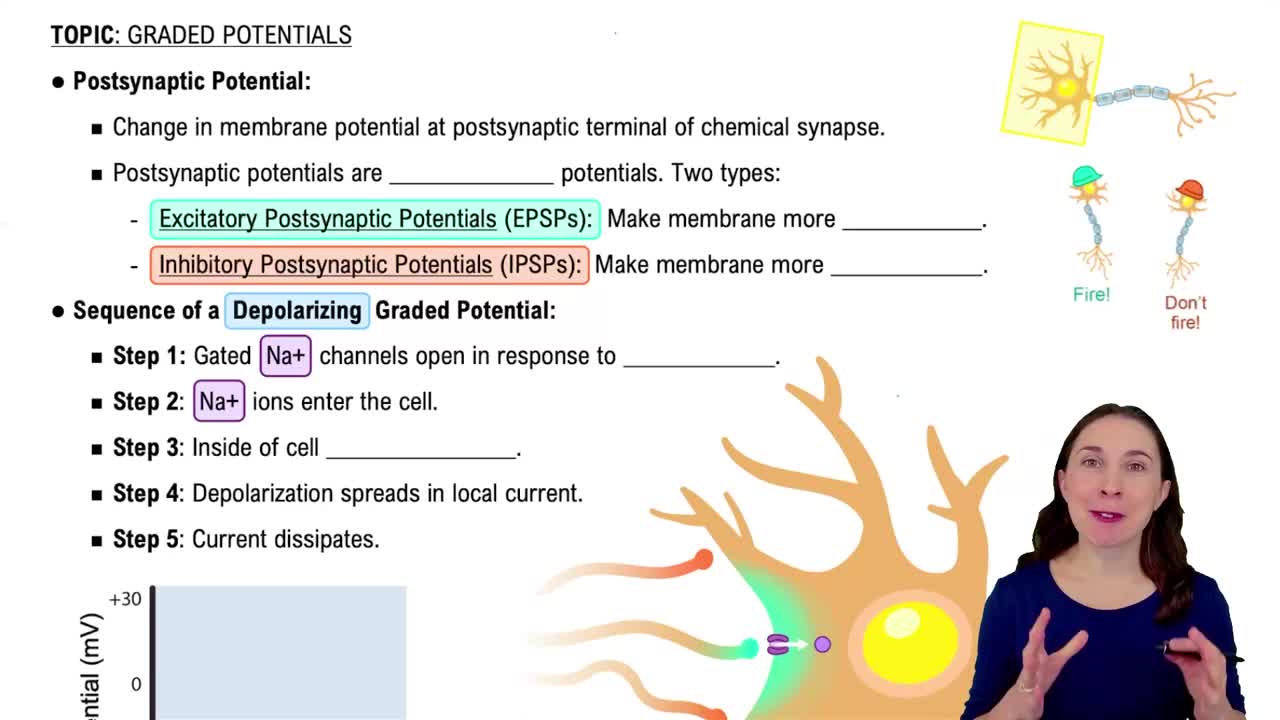
Step 1: Understand what an EPSP (excitatory postsynaptic potential) is. It is a depolarization event on the postsynaptic membrane caused by the influx of positive ions, making the inside of the neuron more positive and closer to the threshold for firing an action potential.
Step 2: Recall that EPSPs are typically generated by the opening of ligand-gated ion channels that allow positively charged ions to enter the cell. The most common ions involved are sodium (Na⁺) and sometimes calcium (Ca²⁺), but potassium (K⁺) usually moves out of the cell and is associated with inhibitory potentials.
Step 3: Consider the types of ion channels involved in EPSPs. Usually, a single type of channel opens that is permeable to both Na⁺ and K⁺ ions simultaneously, but because the electrochemical gradient favors Na⁺ influx, the net effect is depolarization.
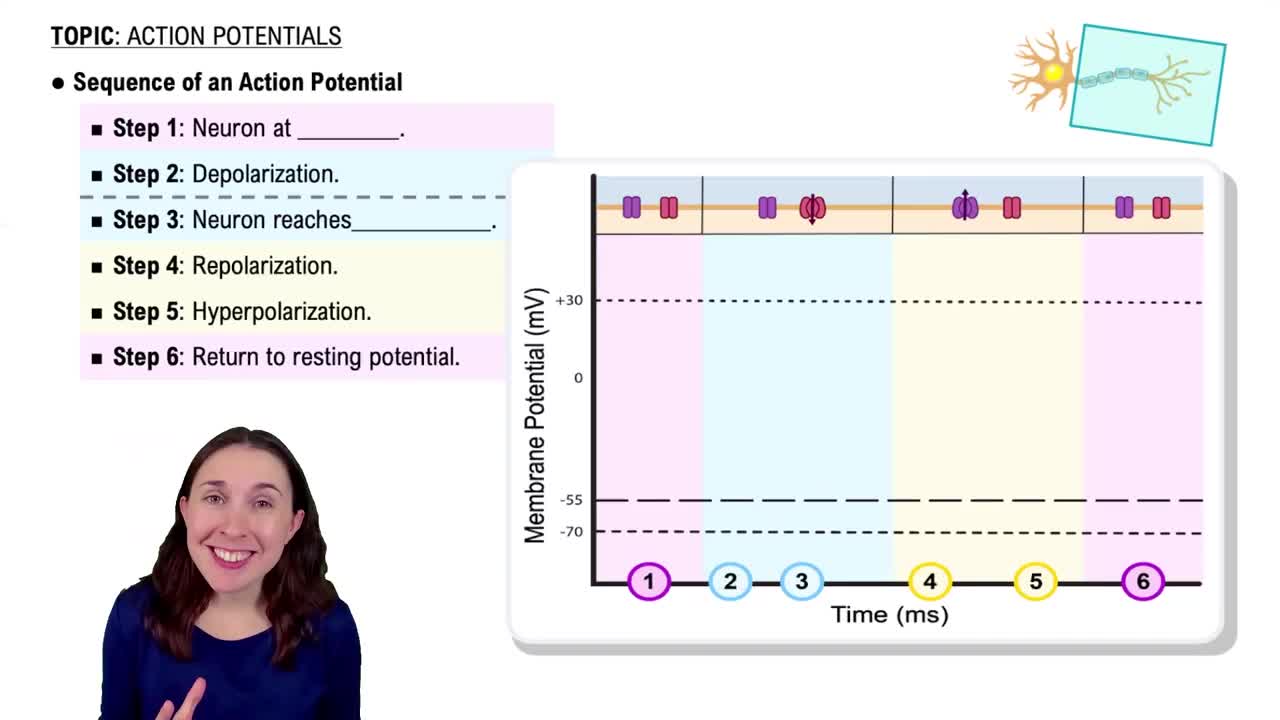
Step 4: Evaluate the answer choices based on this knowledge: specific Na⁺ channels opening alone is less common for EPSPs; specific K⁺ channels opening would cause hyperpolarization (IPSP); sequential opening of Na⁺ then K⁺ channels is characteristic of action potentials, not EPSPs.
Step 5: Conclude that the correct physiological event during an EPSP is the opening of a single type of channel that permits simultaneous flow of Na⁺ and K⁺, with Na⁺ influx dominating to cause depolarization.
Verified video answer for a similar problem:
This video solution was recommended by our tutors as helpful for the problem above
Video duration:
4m
Play a video:
0 Comments
Key Concepts
Here are the essential concepts you must grasp in order to answer the question correctly.
Excitatory Postsynaptic Potential (EPSP)
An EPSP is a temporary depolarization of the postsynaptic membrane caused by the flow of positively charged ions into the neuron. It increases the likelihood that the neuron will fire an action potential by making the membrane potential less negative.
EPSPs typically involve the opening of ligand-gated ion channels that allow the simultaneous flow of Na⁺ and K⁺ ions. These channels are permeable to both ions, but because Na⁺ influx exceeds K⁺ efflux, the membrane depolarizes.
EPSPs are graded, local changes in membrane potential caused by synaptic input, whereas action potentials are all-or-none events involving sequential opening of voltage-gated Na⁺ and K⁺ channels. EPSPs do not involve the sequential opening and closing of these channels.