Ch. 3 The Cell
Amerman - Human Anatomy & Physiology 2nd Edition
Amerman2nd EditionHuman Anatomy & PhysiologyISBN: 9780136873822Not the one you use?Change textbook
Chapter 3, Problem 11f

Mark the following statements about the cytoskeleton as true or false. If a statement is false, correct it to make a true statement.
Endocytosis, exocytosis, muscle cell contraction, and cellular 'crawling' are all mediated by intermediate filaments.

Verified step by step guidance
1
Understand the role of the cytoskeleton: The cytoskeleton is composed of three main types of protein filaments—microfilaments (actin filaments), intermediate filaments, and microtubules. Each type has distinct functions in the cell.
Analyze the processes mentioned in the statement: Endocytosis, exocytosis, muscle cell contraction, and cellular 'crawling' are dynamic processes that involve changes in cell shape and movement.
Recall the specific roles of intermediate filaments: Intermediate filaments primarily provide structural support and mechanical strength to the cell. They are not involved in dynamic processes like endocytosis, exocytosis, or cellular movement.
Identify the cytoskeletal components responsible for the processes: Microfilaments (actin filaments) are involved in endocytosis, exocytosis, muscle cell contraction, and cellular 'crawling' due to their role in cell shape and motility. Microtubules also play a role in vesicle transport during endocytosis and exocytosis.
Correct the false statement: The original statement is false. The corrected statement is: 'Endocytosis, exocytosis, muscle cell contraction, and cellular 'crawling' are all mediated by microfilaments, not intermediate filaments.'

Verified video answer for a similar problem:

This video solution was recommended by our tutors as helpful for the problem above.
Was this helpful?

Key Concepts

Here are the essential concepts you must grasp in order to answer the question correctly.

Cytoskeleton

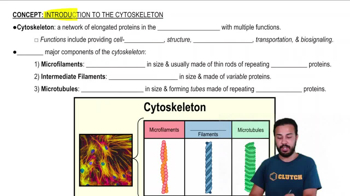
The cytoskeleton is a dynamic network of protein filaments and tubules that provides structural support, shape, and organization to cells. It plays a crucial role in various cellular processes, including intracellular transport, cell division, and maintaining cell integrity. The three main components of the cytoskeleton are microfilaments, intermediate filaments, and microtubules, each serving distinct functions.
Recommended video:
06:05
Introduction to the Cytoskeleton

Intermediate Filaments

Intermediate filaments are one of the three main components of the cytoskeleton, primarily providing mechanical support and stability to cells. They are composed of various proteins, such as keratins and vimentin, and are crucial for maintaining cell shape and resisting tension. Unlike microtubules and microfilaments, intermediate filaments do not play a direct role in cell motility or transport.
Recommended video:
Guided course
6:26
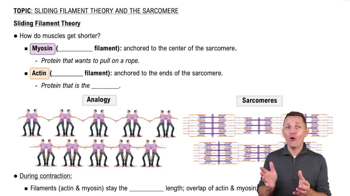
Sliding Filament Theory

Cell Motility Processes

Cell motility processes, such as endocytosis, exocytosis, muscle contraction, and cellular crawling, involve the movement of cells or materials within cells. These processes are primarily mediated by microfilaments and microtubules rather than intermediate filaments. Understanding the specific roles of these cytoskeletal components is essential for accurately assessing the functions and mechanisms of cellular movement.
Recommended video:
Guided course
3:06
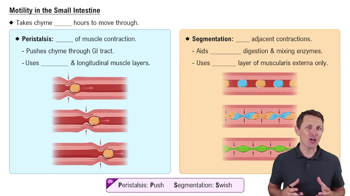
Motility in the Small Intestine