Ch. 29 Development and Inheritance
Martini - Fundamentals of Anatomy & Physiology 11th Edition
Martini, Nath, Bartholomew11th EditionFundamentals of Anatomy & PhysiologyISBN: 9780136874089Not the one you use?Change textbook
Chapter 28, Problem 2

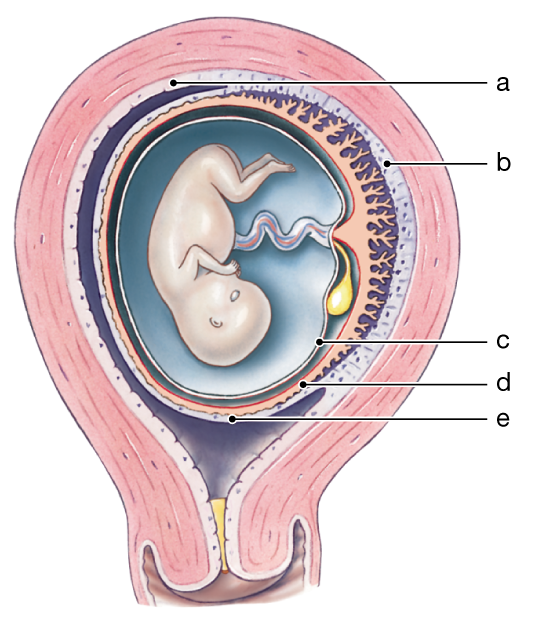
Identify the two extra-embryonic membranes and the three different regions of the endometrium at week 10 of development in the following diagram.
Cross-sectional diagram of a 10-week fetus showing labeled extra-embryonic membranes and endometrium regions.
a. ___
b. ___
c. ___
d. ___
e. ___

Verified step by step guidance
1
Step 1: Understand the context of the problem. At week 10 of embryonic development, the embryo is surrounded by several extra-embryonic membranes that support its growth, and the endometrium (lining of the uterus) has distinct regions that interact with the developing embryo.
Step 2: Identify the two extra-embryonic membranes. These typically include the amnion, which forms the amniotic sac filled with fluid to protect the embryo, and the chorion, which contributes to the formation of the placenta and surrounds the embryo and other membranes.
Step 3: Recognize the three different regions of the endometrium at this stage. These regions are usually the decidua basalis (the part of the endometrium directly beneath the implanted embryo), the decidua capsularis (the part of the endometrium that covers the embryo), and the decidua parietalis (the remaining part of the endometrium lining the uterus).
Step 4: Use the diagram to match the labels a, b, c, d, and e to these structures. Typically, two of these labels will correspond to the extra-embryonic membranes (amnion and chorion), and the other three will correspond to the endometrial regions (decidua basalis, decidua capsularis, and decidua parietalis).
Step 5: Confirm your identifications by reviewing the characteristics of each structure in the diagram, such as location relative to the embryo and uterine wall, and the presence of fluid-filled spaces or placental tissue.

Verified video answer for a similar problem:

This video solution was recommended by our tutors as helpful for the problem above.
Was this helpful?

Key Concepts

Here are the essential concepts you must grasp in order to answer the question correctly.

Extra-embryonic Membranes

Extra-embryonic membranes are structures that support the developing embryo but are not part of the embryo itself. Key membranes include the amnion, which encloses the amniotic cavity, and the chorion, which contributes to placenta formation. Understanding their roles and appearance at week 10 is essential for identifying them in developmental diagrams.
Recommended video:
3:05
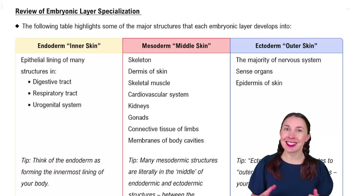
Review of Embryonic Layer Specialization

Regions of the Endometrium

The endometrium is the inner lining of the uterus, which undergoes changes during pregnancy. At week 10, it is divided into three regions: the decidua basalis (beneath the implantation site), decidua capsularis (overlying the embryo), and decidua parietalis (remaining uterine lining). Recognizing these regions helps in understanding maternal-embryonic interactions.
Recommended video:
Guided course
04:21
The 9 Abdominopelvic Regions

Embryonic Development Timeline at Week 10

By week 10, the embryo is transitioning into the fetal stage, and key structures like extra-embryonic membranes and endometrial regions are well-defined. Familiarity with the developmental milestones and anatomical changes at this stage aids in correctly identifying structures in diagrams and understanding their functional significance.
Recommended video:
0:43
Embryonic Development (Weeks 3-8) Example 3