Define immunocompetence and self-tolerance. How is self-tolerance achieved?
Ch. 21 The Immune System: Innate and Adaptive Body Defenses

Marieb, Hoehn7th EditionHuman Anatomy & PhysiologyISBN: 9780805359091Not the one you use?Change textbook
All textbooks
Marieb, Hoehn 7th Edition
Ch. 21 The Immune System: Innate and Adaptive Body Defenses
Problem 15
Marieb, Hoehn 7th Edition
Ch. 21 The Immune System: Innate and Adaptive Body Defenses
Problem 15Chapter 20, Problem 15
Interferons are referred to as antiviral proteins. What stimulates their production, and how do they protect uninfected cells? Which cells of the body secrete interferons?
Verified step by step guidance1
Understand that interferons are proteins produced by cells in response to viral infections; their production is stimulated when a cell detects the presence of viral components, such as viral RNA or DNA, inside it.
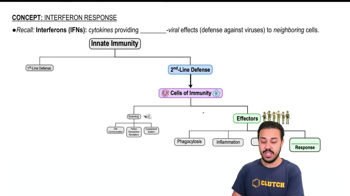
Recognize that once produced, interferons are secreted and bind to receptors on neighboring uninfected cells, triggering these cells to produce antiviral proteins that inhibit viral replication, thereby protecting them from infection.
Identify that interferons do not directly kill viruses but instead activate cellular mechanisms that interfere with viral replication and enhance the immune response.
Know that various cells can secrete interferons, including virus-infected cells themselves, as well as immune cells such as macrophages, dendritic cells, and lymphocytes.
Summarize that interferons act as signaling molecules alerting nearby cells to the viral threat, enabling a rapid and coordinated antiviral defense across tissues.

Verified video answer for a similar problem:
This video solution was recommended by our tutors as helpful for the problem above.
Video duration:
3mWas this helpful?
Key Concepts
Here are the essential concepts you must grasp in order to answer the question correctly.
Stimuli for Interferon Production
Interferons are produced in response to viral infections. When a cell detects viral components like double-stranded RNA, it triggers the synthesis and release of interferons to alert neighboring cells and initiate an antiviral state.
Recommended video:
Interferons
Mechanism of Interferon Protection
Interferons protect uninfected cells by binding to their surface receptors, activating signaling pathways that induce the expression of antiviral proteins. These proteins inhibit viral replication and enhance immune responses, preventing the spread of infection.
Recommended video:
Interferons
Cells that Secrete Interferons
Various cells secrete interferons, primarily virus-infected cells, as well as immune cells like macrophages, dendritic cells, and lymphocytes. These cells produce different types of interferons (Type I, II, III) to coordinate the antiviral defense.
Recommended video:
Interferons
Related Practice
Textbook Question
1
views
Textbook Question
Besides acting as mechanical barriers, the skin epidermis and mucosae of the body have other attributes that contribute to their protective roles. Cite the common body locations and the importance of mucus, lysozyme, keratin, acid pH, and cilia.
1
views
Textbook Question
Differentiate between a primary and a secondary immune response. Which is more rapid and why?
1
views
Textbook Question
What is complement? How does it cause bacterial lysis? What are some of the other roles of complement?
2
views
Textbook Question
Name the five antibody classes and describe where each is most likely to be found in the body.
1
views
Textbook Question
Define antibody. Using an appropriately labeled diagram, describe the structure of an antibody monomer. Indicate and label variable and constant regions, heavy and light chains.
1
views