Transcription .
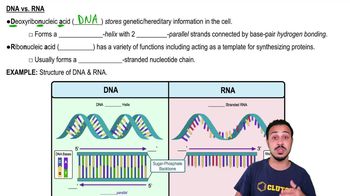
a. synthesizes new daughter DNA molecules from an existing DNA molecule;
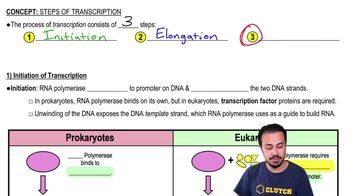
b. results in the synthesis of an RNA copy of a gene;
c. pairs thymines (T) with adenines (A);
d. occurs on ribosomes
Verified step by step guidance
1
Identify the process described in each option: a) DNA replication, b) Transcription, c) Base pairing in DNA, d) Translation.
Understand that DNA replication involves synthesizing new DNA molecules, which matches option a.
Recognize that transcription is the process of synthesizing RNA from a DNA template, which corresponds to option b.
Recall that in DNA, adenine (A) pairs with thymine (T), which is described in option c.
Know that translation occurs on ribosomes, where mRNA is used to synthesize proteins, which is option d.
Verified video answer for a similar problem:
This video solution was recommended by our tutors as helpful for the problem above.
Video duration:
2m
Play a video:
0 Comments
Key Concepts
Here are the essential concepts you must grasp in order to answer the question correctly.
Transcription Process
Transcription is the biological process where the information in a gene's DNA is copied into messenger RNA (mRNA). This process occurs in the nucleus of eukaryotic cells and is essential for gene expression, allowing the genetic code to be translated into proteins.
During transcription, RNA polymerase synthesizes a single strand of RNA by pairing complementary RNA nucleotides with the DNA template strand. This results in the formation of an RNA copy of the gene, which can then be translated into a protein.
In transcription, the base pairing rules dictate that adenine (A) in the DNA pairs with uracil (U) in RNA, while cytosine (C) pairs with guanine (G). This is crucial for ensuring the accurate transfer of genetic information from DNA to RNA.

 2:51 minutes
 Verified step by step guidance
 04:16
04:16