Ch. 12 The Lymphatic System and Body Defenses
Marieb - Essentials of Human Anatomy & Physiology 13th Edition
Marieb13th EditionEssentials of Human Anatomy & PhysiologyISBN: 9780135624340Not the one you use?Change textbook
Chapter 12, Problem 4

More than one choice may apply.
Which of the following are part of MALT?
a. Tonsils
b. Thymus
c. Peyer’s patches
d. Any lymphoid tissue along the digestive tract

Verified step by step guidance
1
Understand the key terms: The antigen-binding site is the specific region on an antibody that binds to an antigen. The epitope is the specific part of the antigen that is recognized and bound by the antibody.
Recall that the interaction between the antigen-binding site and the epitope is highly specific, often compared to a 'lock-and-key' mechanism. This specificity is due to the complementary shapes and chemical properties of the two regions.
Recognize that the binding involves non-covalent interactions such as hydrogen bonds, ionic bonds, van der Waals forces, and hydrophobic interactions. These forces collectively stabilize the antigen-antibody complex.
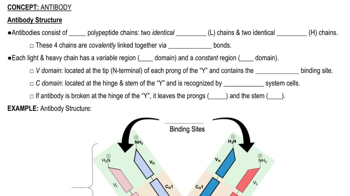
Consider the structural compatibility: The antigen-binding site is formed by the variable regions of the antibody's heavy and light chains, which create a unique shape to match the epitope.
Conclude that this interaction is crucial for the immune response, as it allows the antibody to neutralize the antigen or mark it for destruction by other immune cells.

Verified video answer for a similar problem:

This video solution was recommended by our tutors as helpful for the problem above.
Video duration:
1m
Was this helpful?

Key Concepts

Here are the essential concepts you must grasp in order to answer the question correctly.

Antibody Structure

Antibodies, or immunoglobulins, are Y-shaped proteins produced by B cells that play a crucial role in the immune response. They consist of two heavy chains and two light chains, forming a variable region that includes the antigen-binding site. This site is specifically shaped to recognize and bind to a particular epitope on an antigen, allowing for targeted immune responses.
Recommended video:
5:40
Antibody Structure

Antigen-Epitope Interaction

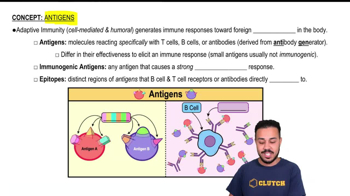
An antigen is any substance that can provoke an immune response, while an epitope is the specific part of the antigen that is recognized by the antibody. The interaction between the antibody's binding site and the epitope is highly specific, akin to a lock and key, which is essential for the immune system to accurately identify and neutralize pathogens.
Recommended video:
3:59
Antigens

Affinity and Specificity

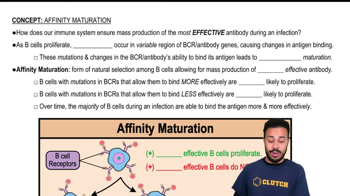
Affinity refers to the strength of the interaction between an antibody and its epitope, while specificity describes the ability of an antibody to bind to a particular epitope over others. High affinity and specificity are critical for effective immune responses, as they ensure that antibodies can efficiently target and eliminate specific pathogens without cross-reacting with similar structures.
Recommended video:
7:27
Affinity Maturation