Ch. 21 The Immune System: Innate and Adaptive Body Defenses
Marieb - Human Anatomy & Physiology 7th Edition
Marieb, Hoehn7th EditionHuman Anatomy & PhysiologyISBN: 9780805359091Not the one you use?Change textbook
Chapter 20, Problem 17

Differentiate between a primary and a secondary immune response. Which is more rapid and why?

Verified step by step guidance
1
Step 1: Define the primary immune response as the body's first exposure to a specific antigen, during which naive B and T lymphocytes are activated, leading to a slower and smaller production of antibodies and immune cells.
Step 2: Define the secondary immune response as the immune reaction upon subsequent exposures to the same antigen, where memory B and T cells generated during the primary response are quickly reactivated.
Step 3: Explain that the secondary immune response is more rapid because memory cells recognize the antigen faster and proliferate more quickly than naive cells, leading to a faster and stronger production of antibodies.
Step 4: Highlight that the secondary response typically produces a higher concentration of antibodies, often with greater affinity, compared to the primary response.
Step 5: Summarize that the key difference lies in the presence of memory cells in the secondary response, which enables a quicker and more effective immune defense upon re-exposure to the antigen.

Verified video answer for a similar problem:

This video solution was recommended by our tutors as helpful for the problem above.
Video duration:
3m

Key Concepts

Here are the essential concepts you must grasp in order to answer the question correctly.

Primary Immune Response

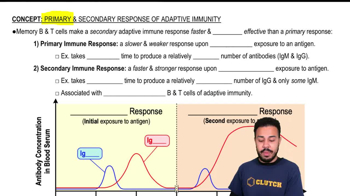
The primary immune response occurs when the immune system encounters a pathogen for the first time. It involves the activation of naive B and T cells, leading to the production of antibodies and memory cells. This response is slower, typically taking days to weeks, as the body is building its defense from scratch.
Recommended video:
Guided course
6:59
Primary and Secondary Response of Adaptive Immunity

Secondary Immune Response

The secondary immune response happens upon subsequent exposure to the same pathogen. Memory B and T cells generated during the primary response quickly recognize the antigen, resulting in a faster and stronger production of antibodies. This rapid response often prevents reinfection or reduces disease severity.
Recommended video:
Guided course
6:59
Primary and Secondary Response of Adaptive Immunity

Immunological Memory

Immunological memory is the ability of the immune system to remember a previous encounter with a pathogen through memory cells. It enables a quicker and more effective response during secondary exposure. This concept explains why the secondary immune response is more rapid and robust compared to the primary response.
Recommended video:
Guided course
7:56
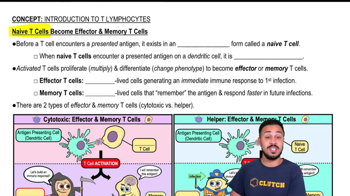
Naive T Cells Become Effector & Memory T Cells