Ch. 13 The Peripheral Nervous System
Amerman - Human Anatomy & Physiology 2nd Edition
Amerman2nd EditionHuman Anatomy & PhysiologyISBN: 9780136873822Not the one you use?Change textbook
Chapter 13, Problem L1.10

Merkel cell fibers, tactile corpuscles, Ruffini endings, and lamellated corpuscles are all types of:
a. Nociceptors
b. Mechanoreceptors
c. Photoreceptors
d. Chemoreceptors

Verified step by step guidance
1
Step 1: Understand the question. The problem is asking you to identify the category of sensory receptors to which Merkel cell fibers, tactile corpuscles, Ruffini endings, and lamellated corpuscles belong.
Step 2: Recall the definitions of the options provided: a) Nociceptors detect pain, b) Mechanoreceptors detect mechanical stimuli like touch, pressure, and vibration, c) Photoreceptors detect light, and d) Chemoreceptors detect chemical changes.
Step 3: Review the function of each receptor type mentioned in the question: Merkel cell fibers detect light touch, tactile corpuscles detect fine touch and vibration, Ruffini endings detect stretch, and lamellated corpuscles detect deep pressure and vibration.
Step 4: Match the functions of these receptors to the correct category. Since all these receptors respond to mechanical stimuli such as touch, pressure, or vibration, they fall under the category of mechanoreceptors.
Step 5: Conclude that the correct answer is the category that aligns with the function of these receptors, which is mechanoreceptors (option b).

Verified video answer for a similar problem:

This video solution was recommended by our tutors as helpful for the problem above.
Was this helpful?

Key Concepts

Here are the essential concepts you must grasp in order to answer the question correctly.

Mechanoreceptors

Mechanoreceptors are specialized sensory receptors that respond to mechanical pressure or distortion. They play a crucial role in the sensation of touch, vibration, and proprioception. The types mentioned in the question, such as Merkel cell fibers and tactile corpuscles, are examples of mechanoreceptors that detect different aspects of mechanical stimuli.
Recommended video:
4:49
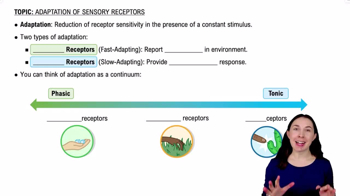
Adaptation

Types of Mechanoreceptors

There are several types of mechanoreceptors, each with distinct functions. Merkel cell fibers are responsible for detecting light touch, while tactile corpuscles (Meissner's corpuscles) respond to changes in texture and light touch. Ruffini endings are sensitive to skin stretch, and lamellated corpuscles (Pacinian corpuscles) detect deep pressure and vibration, illustrating the diversity of mechanoreceptive functions.
Recommended video:
01:06
Types of Phosphorylation

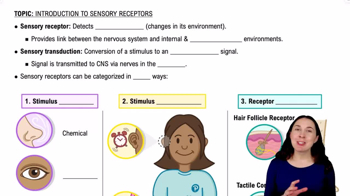
Sensory Receptors

Sensory receptors are specialized cells that convert external stimuli into neural signals for the brain to interpret. They are categorized based on the type of stimulus they detect, such as nociceptors for pain, photoreceptors for light, and chemoreceptors for chemical stimuli. Understanding the classification of sensory receptors is essential for identifying the correct answer to the question regarding mechanoreceptors.
Recommended video:
2:47
Sensory Receptors