
Ch. 3 The Cell
Amerman - Human Anatomy & Physiology 2nd Edition
Amerman2nd EditionHuman Anatomy & PhysiologyISBN: 9780136873822Not the one you use?Change textbook
Chapter 3, Problem 5a

Mark the following statements about the plasma membrane as true or false. If a statement is false, correct it to make a true statement.
Integral membrane proteins generally span the width of the plasma membrane, whereas peripheral proteins are found on only one side of the membrane.

Verified step by step guidance
1
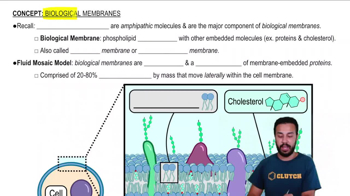
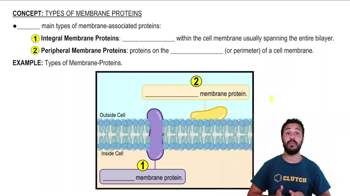
Understand the structure of the plasma membrane: The plasma membrane is a phospholipid bilayer with embedded proteins. Integral membrane proteins are embedded within the bilayer, often spanning its entire width, while peripheral proteins are attached to only one side of the membrane, either the extracellular or intracellular surface.
Analyze the first part of the statement: 'Integral membrane proteins generally span the width of the plasma membrane.' This is true because integral proteins are embedded within the hydrophobic core of the bilayer and often extend across the entire membrane, functioning as channels, transporters, or receptors.
Analyze the second part of the statement: 'Peripheral proteins are found on only one side of the membrane.' This is also true because peripheral proteins are not embedded in the bilayer but are loosely attached to the surface, often interacting with integral proteins or the polar heads of phospholipids.
Determine if the statement as a whole is true or false: Since both parts of the statement are accurate, the entire statement is true.
Conclude the evaluation: No corrections are needed for this statement as it accurately describes the roles and locations of integral and peripheral membrane proteins in the plasma membrane.

Verified video answer for a similar problem:

This video solution was recommended by our tutors as helpful for the problem above.
Was this helpful?

Key Concepts

Here are the essential concepts you must grasp in order to answer the question correctly.

Plasma Membrane Structure

The plasma membrane is a phospholipid bilayer that separates the interior of the cell from the external environment. It is composed of various proteins, lipids, and carbohydrates, which contribute to its fluidity and functionality. Understanding the structure is essential for recognizing how integral and peripheral proteins interact with the membrane.
Recommended video:
06:49
Biological Membranes

Integral vs. Peripheral Proteins

Integral membrane proteins are embedded within the lipid bilayer and often span the entire membrane, playing crucial roles in transport and signaling. In contrast, peripheral proteins are attached to the exterior or interior surfaces of the membrane and are involved in signaling pathways and maintaining the cell's shape. This distinction is vital for evaluating the accuracy of statements about membrane proteins.
Recommended video:
03:05
Types of Membrane Proteins

Membrane Fluidity

Membrane fluidity refers to the viscosity of the lipid bilayer, which affects the movement and function of membrane proteins. Factors such as temperature, lipid composition, and the presence of cholesterol influence fluidity. A proper understanding of membrane fluidity is important for comprehending how proteins interact within the plasma membrane and how they can be classified as integral or peripheral.
Recommended video:
06:49
Biological Membranes
Related Practice
Textbook Question

Match the following terms with the correct functions.

_____Peroxisome    

_____Ribosome    

_____Smooth endoplasmic reticulum    

_____Mitochondrion    

_____Golgi apparatus    

_____Lysosome    

_____Rough endoplasmic reticulum     

_____Vesicle


a. Modifies and folds proteins into the correct structure

b. Modifies, packages, and sorts proteins

c. Contains digestive enzymes

d. Granular organelle that makes proteins

e. Synthesizes most of a cell's ATP

f. Contains enzymes that oxidize toxins and fatty acids

g. Membrane-enclosed structure used to transport substances through the cell

h. Detoxifies certain chemicals, makes lipids, stores calcium ions

1
views
Textbook Question

Mark the following statements about the plasma membrane as true or false. If a statement is false, correct it to make a true statement.

Membrane proteins often function as channels or carriers.

4
views
Textbook Question

Mark the following statements about the plasma membrane as true or false. If a statement is false, correct it to make a true statement.

Membrane cholesterol is vital for cell-cell recognition.

1
views
Textbook Question

Which of the following best describes the arrangement of the main component of the plasma membrane?

a. A monolayer of phospholipids with the phosphate heads facing the cytosol and the fatty acid tails facing the extracellular fluid

b. A bilayer of phospholipids with the phosphate heads facing the cytosol and extracellular fluid, and the fatty acid tails facing one another

c. A bilayer of phospholipids with the phosphate heads of one layer facing the fatty acid tails of the other

d. A bilayer of phospholipids with a layer of triglycerides sandwiched in the middle

1
views
Textbook Question

Mark the following statements about the plasma membrane as true or false. If a statement is false, correct it to make a true statement.

Cholesterol provides the plasma membrane with stability in the face of changing ion concentrations.

Textbook Question

Write a single sentence, using no more than 25 words, to summarize each of the following cellular processes:

Primary active transport

1
views