Ch. 13 The Peripheral Nervous System
Amerman - Human Anatomy & Physiology 2nd Edition
Amerman2nd EditionHuman Anatomy & PhysiologyISBN: 9780136873822Not the one you use?Change textbook
Chapter 13, Problem L2.2

Predict what might happen if nociceptors were rapidly adapting instead of slowly adapting receptors. Would this change be beneficial or potentially harmful?

Verified step by step guidance
1
Understand the role of nociceptors: Nociceptors are specialized sensory receptors responsible for detecting pain stimuli. They are typically slowly adapting receptors, meaning they continue to respond to a stimulus as long as it persists, ensuring the body remains aware of potential harm.
Define rapid adaptation: Rapidly adapting receptors respond quickly to a stimulus but cease firing even if the stimulus persists. This type of adaptation is common in receptors that detect changes rather than sustained stimuli, such as those involved in touch or vibration.
Predict the consequences of rapid adaptation in nociceptors: If nociceptors were rapidly adapting, they would stop signaling pain shortly after the initial stimulus, even if the harmful stimulus (e.g., injury or inflammation) continued. This could lead to a lack of awareness of ongoing damage, potentially worsening the injury or delaying treatment.
Evaluate the potential harm: Rapid adaptation in nociceptors could be harmful because pain serves as a protective mechanism, alerting the body to avoid further damage and seek healing. Without sustained pain signaling, individuals might unknowingly exacerbate injuries or fail to address underlying conditions.
Consider the potential benefits: While rapid adaptation might reduce discomfort, it would likely compromise the body's ability to protect itself from harm. Pain is essential for survival, as it prompts behavioral changes to prevent further injury and supports recovery processes.

Verified video answer for a similar problem:

This video solution was recommended by our tutors as helpful for the problem above.
Was this helpful?

Key Concepts

Here are the essential concepts you must grasp in order to answer the question correctly.

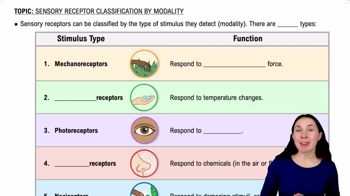
Nociceptors

Nociceptors are specialized sensory receptors responsible for detecting harmful stimuli that can cause pain. They respond to various types of damaging stimuli, including mechanical, thermal, and chemical signals. Understanding their function is crucial for analyzing pain perception and the body's response to injury.
Recommended video:
2:11
Sensory Receptor Classification by Modality

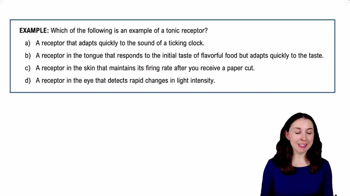
Adaptation of Receptors

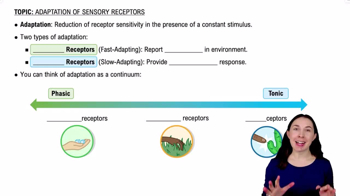
Adaptation refers to the process by which sensory receptors become less responsive to constant stimuli over time. Slowly adapting receptors, like nociceptors, maintain their response to persistent pain, allowing the body to remain aware of ongoing harm. In contrast, rapidly adapting receptors would decrease their response quickly, potentially leading to a lack of awareness of ongoing injury.
Recommended video:
1:17
Adaptation of Sensory Receptors Example 1

Implications of Rapid Adaptation

If nociceptors were to adapt rapidly, the body might fail to recognize continuous pain signals, which could lead to inadequate responses to injuries. This change could be harmful, as it may prevent individuals from taking necessary actions to protect themselves from further damage, ultimately compromising health and safety.
Recommended video:
4:49
Adaptation
Related Practice
Textbook Question

Complaining of muscle weakness, Delia goes to the doctor. Devise a series of physical examination tests that would help to determine if her problem involves upper or lower motor neurons.

1
views
Textbook Question

Match each type of neuroglial cell with its correct function.

____ Schwann cells    

____ Ependymal cells     

____ Microglial cells    

____ Oligodendrocytes     

____ Satellite cells    

____ Astrocytes

a. Phagocytic cells of the CNS

b. Surround the cell bodies of neurons in the PNS

c. Create the myelin sheath in the PNS

d. Anchor neurons and blood vessels, maintain extracellular environment around neurons, assist in repair of damaged brain tissue

e. Create the myelin sheath in the CNS

f. Ciliated cells in the CNS that produce and circulate the fluid around the brain and spinal cord

1
views
Textbook Question

Maria is a 3-year-old who has been diagnosed with CIPA, or congenital insensitivity to pain with anhidrosis. This disease results from a genetic mutation that causes essentially all general sensory neurons to not function properly. What types of sensations will Maria be unable to detect (be specific)? Predict what problems she might face from her condition.

5
views
Textbook Question

A spinal nerve divides into a(n)_____ that serves the anterior side of the body and the limbs and a(n)_____that serves the posterior side of the body.

1
views
Textbook Question

Explain why you lose both motor and sensory function of a part of your body when a spinal nerve is numbed with anesthetic agents.

4
views
Textbook Question

Devise a series of physical examination tests that assess the function of each of the cranial nerves.

8
views