Ch. 12 The Lymphatic System and Body Defenses
Marieb - Essentials of Human Anatomy & Physiology 13th Edition
Marieb13th EditionEssentials of Human Anatomy & PhysiologyISBN: 9780135624340Not the one you use?Change textbook
Chapter 12, Problem 2

More than one choice may apply.
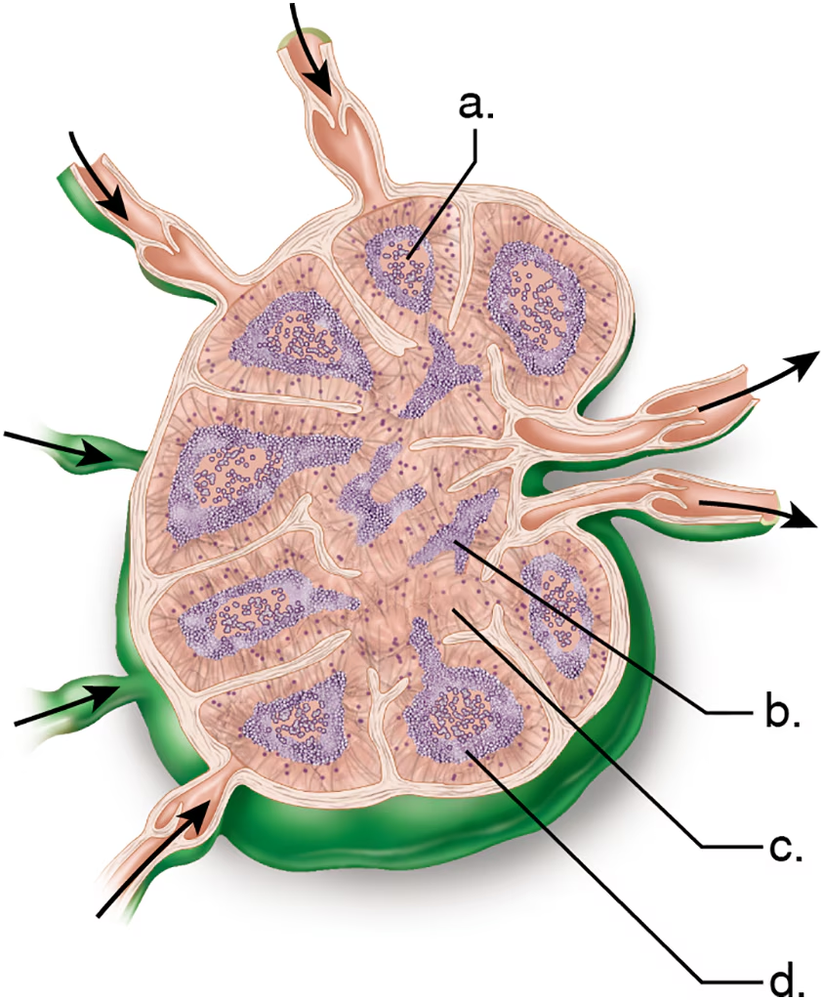
Which parts of the lymph node show increased activity when antibody production is high?
Illustration of a lymph node highlighting areas of increased activity during high antibody production, labeled a, b, c, and d.

Verified step by step guidance
1
Step 1: Understand the structure of a lymph node. A lymph node is divided into regions: the cortex, paracortex, and medulla. Each region has specific functions related to immune responses.
Step 2: Recall the role of B cells in antibody production. B cells are primarily responsible for producing antibodies, and they are located in specific areas of the lymph node.
Step 3: Identify the regions of the lymph node where B cells are most active. The germinal centers within the cortex are areas where B cells proliferate, differentiate, and produce antibodies during an immune response.
Step 4: Consider the medulla of the lymph node. The medullary cords contain plasma cells, which are differentiated B cells actively secreting antibodies.
Step 5: Review the options provided in the question and match them to the regions of the lymph node (e.g., germinal centers in the cortex and medullary cords in the medulla) that show increased activity during antibody production.

Verified video answer for a similar problem:

This video solution was recommended by our tutors as helpful for the problem above.
Video duration:
1m
Was this helpful?

Key Concepts

Here are the essential concepts you must grasp in order to answer the question correctly.

Lymph Node Structure

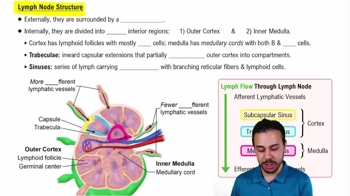
Lymph nodes are small, bean-shaped structures that play a crucial role in the immune system. They contain various regions, including the cortex, paracortex, and medulla, each with specific functions. The cortex houses follicles that contain B cells, while the paracortex is rich in T cells. Understanding these structures is essential for identifying where antibody production occurs during immune responses.
Recommended video:
10:32
Lymph Node Structure

B Cell Activation

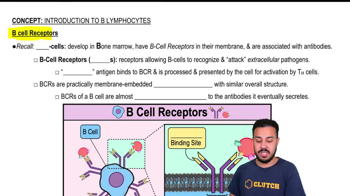
B cells are a type of white blood cell responsible for producing antibodies. When activated by antigens, they proliferate and differentiate into plasma cells, which secrete large amounts of antibodies. This process primarily occurs in the germinal centers of the lymph node follicles, making it a key area to examine when antibody production is high.
Recommended video:
4:37
B Cell Receptors

Germinal Centers

Germinal centers are specialized structures within the lymph node follicles where B cells undergo rapid division and maturation in response to an antigen. These centers are critical for affinity maturation and class switching of antibodies, processes that enhance the effectiveness of the immune response. Increased activity in germinal centers indicates heightened antibody production, making them a focal point in understanding immune responses.
Recommended video:
1:51
Secondary Lymphoid Organs: Lymph Nodes Example 2