
Ch. 11 Introduction to the Nervous System and Nervous Tissue
Amerman - Human Anatomy & Physiology 2nd Edition
Amerman2nd EditionHuman Anatomy & PhysiologyISBN: 9780136873822Not the one you use?Change textbook
Chapter 11, Problem 7

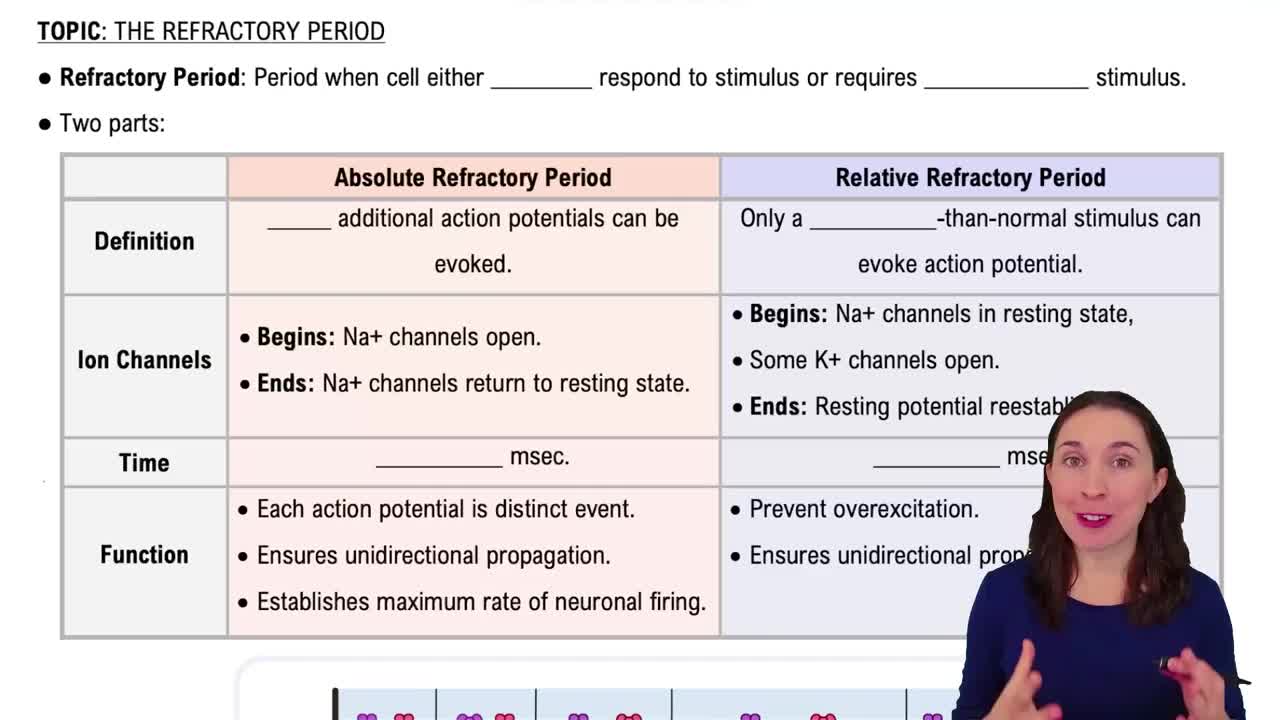
The ________ is the period of time during which it is impossible to stimulate a neuron to have an action potential, whereas the ________ is the period of time during which a larger-than-normal stimulus is required to elicit an action potential.

Verified step by step guidance
1
Step 1: Understand the context of the problem. The question is asking about two distinct periods in the process of neuron action potential generation. These periods are related to the neuron's ability to respond to stimuli after an action potential has occurred.
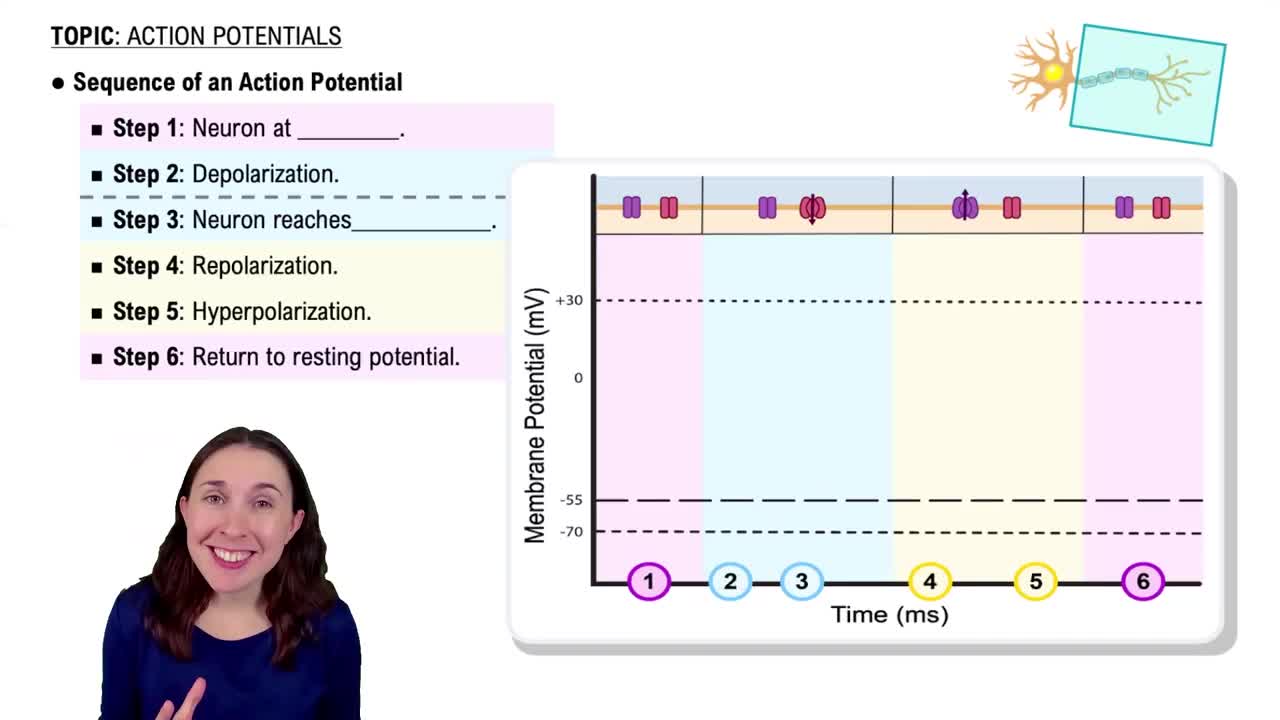
Step 2: Recall the phases of an action potential. During an action potential, the neuron undergoes depolarization, repolarization, and hyperpolarization. These phases are critical to understanding the refractory periods.
Step 3: Define the absolute refractory period. This is the period of time during which it is impossible for a neuron to generate another action potential, regardless of the strength of the stimulus. This occurs because the sodium (Na⁺) channels are inactivated and cannot reopen until the membrane potential returns to a resting state.
Step 4: Define the relative refractory period. This is the period of time during which a neuron can generate another action potential, but only if the stimulus is stronger than normal. This occurs because the membrane is hyperpolarized, making it more difficult to reach the threshold for depolarization.
Step 5: Match the terms to the blanks in the question. The absolute refractory period corresponds to the first blank, and the relative refractory period corresponds to the second blank. This distinction is crucial for understanding how neurons regulate the frequency of action potentials.

Verified video answer for a similar problem:

This video solution was recommended by our tutors as helpful for the problem above.
Was this helpful?

Key Concepts

Here are the essential concepts you must grasp in order to answer the question correctly.

Absolute Refractory Period

The absolute refractory period is the phase during which a neuron cannot generate another action potential, regardless of the strength of the stimulus. This occurs because the sodium channels are inactivated after an action potential, preventing any new depolarization. This period ensures that action potentials are discrete events and helps maintain the unidirectional flow of signals along the neuron.
Recommended video:
06:26
Refractory Period

Relative Refractory Period

The relative refractory period follows the absolute refractory period and is characterized by the need for a stronger-than-normal stimulus to trigger an action potential. During this time, some sodium channels have returned to a resting state, but potassium channels remain open, making it more difficult to depolarize the neuron. This period allows for the possibility of action potentials but requires greater stimulation.
Recommended video:
06:26
Refractory Period

Action Potential

An action potential is a rapid, temporary change in the membrane potential of a neuron, allowing it to transmit signals. It occurs when a neuron depolarizes past a certain threshold, leading to the opening of voltage-gated sodium channels. This process is crucial for neuronal communication, as it enables the propagation of electrical signals along the axon to communicate with other neurons or muscles.
Recommended video:
03:53
Action Potential
Related Practice
Textbook Question

Identify the following as properties of electrical synapses (ES), chemical synapses (CS), or both (B).           

a. ______ The plasma membranes of presynaptic and postsynaptic neurons are joined by gap junctions.          

b. ______ Transmission is unidirectional and delayed.          

c. ______ A presynaptic neuron and a postsynaptic neuron are involved.          

d. ______ The use of neurotransmitters packaged into synaptic vesicles is required.          

e. ______ Transmission is nearly instantaneous and bidirectional.

3
views
Textbook Question

Describe the three components of the neuromuscular junction.

Textbook Question

Mark the following statements as true or false. If a statement is false, correct it to make a true statement.

The Na+/K+ pumps and gated channels maintain the Na+ and K+ gradients necessary for action potentials to occur.

Textbook Question

Mark the following statements as true or false. If a statement is false, correct it to make a true statement.

A depolarization is a change in membrane potential that makes the potential less negative.

4
views
Textbook Question

Which of the following statements best describes saltatory conduction?

a. Every section of the axolemma must be depolarized and triggered to generate an action potential.

b. The internodes must generate action potentials.

c. The dendrites and cell bodies propagate EPSPs toward the trigger zone.

d. Only the nodes of Ranvier must generate action potentials.

1
views
Textbook Question

The trigger for exocytosis of synaptic vesicles from the presynaptic neuron is:

a. Arrival of an action potential at the axon terminal and influx of calcium ions.

b. Summation of IPSPs at the presynaptic neuron.

c. Binding of neurotransmitters to the axon hillock.

d. Influx of Na+ into the postsynaptic neuron.

1
views