________ are segments of DNA that code for a specific protein, and the human ________ includes over 20,000 of these segments.
Ch. 27 Development and Heredity
Chapter 27, Problem L3.4
Elise is a freshman college student taking Introduction to Biology. In lab, she is asked her parents' blood types to complete a Punnett square. She knows that she has type A blood and that her mother has type B, but she does not know her father's blood type. Elise's lab partner assures her that she can figure out her father's blood type just by knowing her own and her mother's. Is her lab partner correct? Explain why or why not.
Verified step by step guidance1
Understand the basics of blood type inheritance: Blood type is determined by the ABO blood group system, which involves three alleles: A, B, and O. Each person inherits one allele from each parent. The possible genotypes for blood types are: Type A (AA or AO), Type B (BB or BO), Type AB (AB), and Type O (OO).
Analyze Elise's blood type: Elise has type A blood, which means her genotype could be either AA or AO. This indicates that she must have inherited one A allele from one parent and either an A or O allele from the other parent.
Analyze her mother's blood type: Elise's mother has type B blood, which means her genotype could be either BB or BO. This indicates that Elise must have inherited the O allele from her mother, as her own blood type is A and she did not inherit a B allele.
Determine the possibilities for Elise's father's blood type: Since Elise inherited the A allele from her father, her father's genotype must include at least one A allele. This means her father could have type A blood (AA or AO) or type AB blood (AB).
Conclude whether her lab partner is correct: Yes, Elise's lab partner is correct. By analyzing the inheritance patterns and knowing Elise's and her mother's blood types, it is possible to deduce that Elise's father must have a blood type that includes the A allele (type A or type AB).

Verified video answer for a similar problem:
This video solution was recommended by our tutors as helpful for the problem above.
Was this helpful?
Key Concepts
Here are the essential concepts you must grasp in order to answer the question correctly.
Blood Type Inheritance
Blood type inheritance is determined by the ABO blood group system, which includes four main types: A, B, AB, and O. Each person inherits one allele from each parent, which can be A, B, or O. The presence of A or B antigens on the surface of red blood cells determines the blood type, while O is considered a universal donor. Understanding this inheritance pattern is crucial for predicting possible blood types in offspring.
Recommended video:
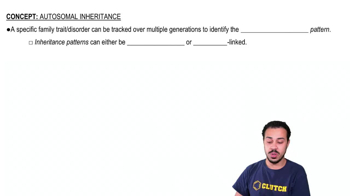
Autosomal Inheritance
Punnett Square
A Punnett square is a graphical tool used to predict the genotypes of offspring from parental genotypes. It organizes the possible combinations of alleles from each parent, allowing for a visual representation of genetic inheritance. In Elise's case, the Punnett square can help determine the potential blood types of her children based on her and her mother's known blood types, but it requires knowledge of her father's genotype.
Recommended video:
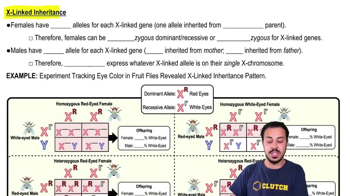
X-Linked Inheritance
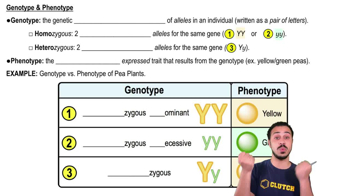
Genotype vs. Phenotype
Genotype refers to the genetic makeup of an individual, while phenotype is the observable physical or biochemical characteristics resulting from the genotype. In the context of blood types, Elise's phenotype is type A, but her genotype could be either AA or AO. Without knowing her father's genotype, Elise cannot definitively determine his blood type, as it could influence her own genetic contribution to their offspring's blood type.
Recommended video:
Genotype & Phenotype
Related Practice
Textbook Question
1
views
Textbook Question
Which pattern of inheritance includes examples of codominance?
a. Autosomal dominant and recessive traits
b. Multiple-allele traits
c. Sex-linked traits
d. Polygenic inheritance
1
views
Textbook Question
Certain diseases are transmitted via mitochondrial DNA. Which cell types do you think would be most affected by such diseases, and why?
4
views
Textbook Question
Determine the probability of a couple having a child with a widow's peak if the conditions are as follows: The gene for widow's peak follows strict autosomal dominant-recessive inheritance. Widow's peak (W) is dominant, and no widow's peak (w) is recessive. The genotype of the mother is Ww, and the genotype of the father is ww.
1
views