Ch. 22 The Lymphatic System and Immunity
Martini - Fundamentals of Anatomy & Physiology 11th Edition
Martini, Nath, Bartholomew11th EditionFundamentals of Anatomy & PhysiologyISBN: 9780136874089Not the one you use?Change textbook
Chapter 22, Problem 12

List the specific functions of each of the body's primary and secondary lymphoid tissues and organs.

Verified step by step guidance
1
Identify the primary lymphoid tissues and organs, which include the bone marrow and thymus, and understand their main function in the immune system.
Explain that the bone marrow is responsible for the production and maturation of all blood cells, including the development of B lymphocytes (B cells).
Describe the thymus as the site where T lymphocytes (T cells) mature and undergo selection processes to ensure self-tolerance and functionality.
List the secondary lymphoid tissues and organs, such as lymph nodes, spleen, tonsils, and mucosa-associated lymphoid tissue (MALT), and recognize their role in immune response activation.
Explain that secondary lymphoid organs serve as sites where mature lymphocytes encounter antigens, become activated, proliferate, and initiate adaptive immune responses.

Verified video answer for a similar problem:

This video solution was recommended by our tutors as helpful for the problem above.
Was this helpful?

Key Concepts

Here are the essential concepts you must grasp in order to answer the question correctly.

Primary Lymphoid Organs

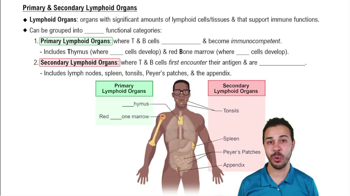
Primary lymphoid organs, including the bone marrow and thymus, are responsible for the production and maturation of lymphocytes. Bone marrow generates all blood cells and matures B cells, while the thymus is where T cells mature and differentiate, preparing them for immune responses.
Recommended video:
2:07
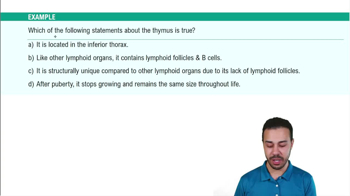
Primary Lymphoid Organs Example 1

Secondary Lymphoid Organs

Secondary lymphoid organs, such as lymph nodes, spleen, and mucosa-associated lymphoid tissue (MALT), serve as sites where mature lymphocytes are activated by encountering antigens. These organs facilitate immune surveillance, lymphocyte proliferation, and initiation of adaptive immune responses.
Recommended video:
4:34
Primary & Secondary Lymphoid Organs

Functions of Lymphoid Tissues

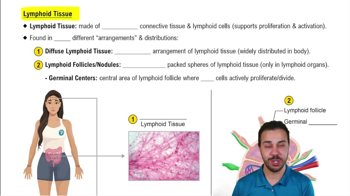
Lymphoid tissues provide structural environments for immune cell interactions, antigen presentation, and lymphocyte activation. They filter lymph or blood to trap pathogens, support immune cell communication, and help generate effective immune responses to protect the body from infections.
Recommended video:
4:55
Lymphoid Tissue