Ch. 9 The Muscular System
Amerman - Human Anatomy & Physiology 2nd Edition
Amerman2nd EditionHuman Anatomy & PhysiologyISBN: 9780136873822Not the one you use?Change textbook
Chapter 9, Problem 9

Which of the erector spinae muscles is most lateral to the vertebral column?
a. Spinalis muscle
b. Iliocostalis muscle
c. Semispinalis muscle
d. Longissimus muscle

Verified step by step guidance
1
Understand the anatomy of the erector spinae muscle group, which consists of three primary muscles: spinalis, longissimus, and iliocostalis. These muscles run parallel to the vertebral column and are responsible for extending and stabilizing the spine.
Identify the relative positions of the muscles within the erector spinae group. The spinalis muscle is the most medial, located closest to the vertebral column. The longissimus muscle is intermediate, positioned between the spinalis and iliocostalis muscles.
Recognize that the iliocostalis muscle is the most lateral of the erector spinae group. It is positioned furthest from the vertebral column and attaches to the ribs and iliac crest, contributing to lateral flexion and extension of the spine.
Exclude the semispinalis muscle from consideration, as it is not part of the erector spinae group. The semispinalis muscle belongs to the transversospinalis group and is located deeper in the back, closer to the vertebral column.
Conclude that the iliocostalis muscle is the correct answer because it is the most lateral muscle within the erector spinae group, based on its anatomical position and function.

Verified video answer for a similar problem:

This video solution was recommended by our tutors as helpful for the problem above.
Was this helpful?

Key Concepts

Here are the essential concepts you must grasp in order to answer the question correctly.

Erector Spinae Muscles

The erector spinae is a group of muscles that run along the spine and are responsible for extending and laterally flexing the vertebral column. This group consists of three primary muscles: iliocostalis, longissimus, and spinalis. Understanding their locations and functions is crucial for identifying which muscle is most lateral.
Recommended video:
Guided course
2:00
Introduction to Muscles and Muscle Tissue Example 1

Muscle Anatomy and Positioning

In anatomy, the positioning of muscles relative to each other is essential for understanding their functions and interactions. The terms 'lateral' and 'medial' describe the position of structures in relation to the midline of the body. In the context of the erector spinae, knowing which muscle lies furthest from the vertebral column helps in answering questions about their anatomical arrangement.
Recommended video:
Guided course
02:40
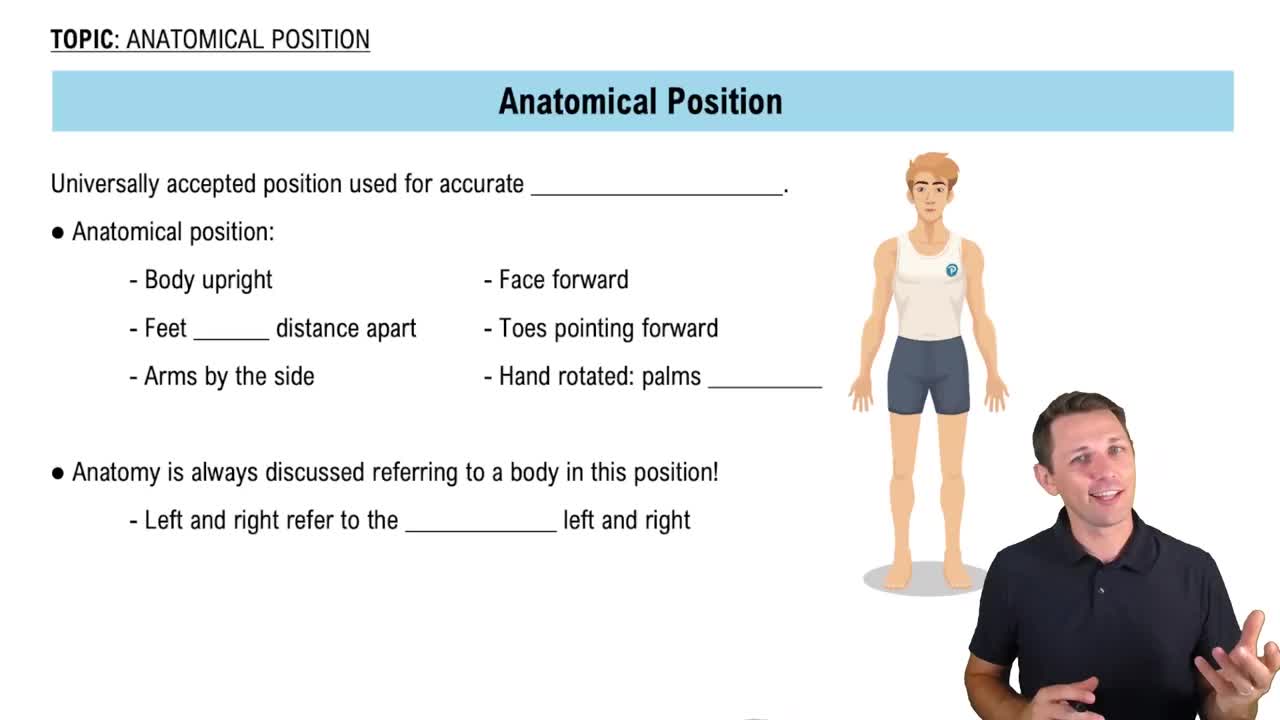
Anatomical Position

Spinal Muscle Functions

The erector spinae muscles play a vital role in maintaining posture and enabling movements of the spine, such as extension and rotation. Each muscle within this group has specific functions and contributes differently to spinal stability and mobility. Recognizing these functions aids in understanding why certain muscles are positioned as they are in relation to the vertebral column.
Recommended video:
06:04
Functional Groups
Related Practice
Textbook Question

Mr. Bell presents with the inability to move certain muscles on one side of his face. You ask him to make various facial expressions and find that on his right side he is unable to purse his lips, pull in his cheeks, elevate his upper lip, and smirk. What muscles is Mr. Bell unable to contract?

2
views
Textbook Question

Which of the following muscle groups is considered muscles of inspiration?

a. External intercostal muscles

b. Internal intercostal muscles

c. External oblique muscles

d. Internal oblique muscles

1
views
Textbook Question

Match the muscle with its main action:

_____Sternocleidomastoid muscle     

_____Transversus abdominis muscle     

_____Internal oblique muscle     

_____Rectus abdominis muscle     

_____Splenius capitis muscle     

_____Quadratus lumborum muscle.

a. Laterally flexes the trunk

b. Flexes the trunk

c. Compresses the abdominal cavity

d. Extends the vertebral column

e. Flexes the head

f. Extends the head

1
views
Textbook Question

Which eye muscle passes through the trochlea and turns the eye inferiorly and laterally?

a. Lateral rectus muscle

b. Inferior rectus muscle

c. Inferior oblique muscle

d. Superior oblique muscle

1
views
Textbook Question

Mark the following statements as true or false. If the statement is false, correct it to make a true statement.

The buccinator muscle pulls the cheeks in, producing sucking movements.

2
views
Textbook Question

The thick, bandlike muscle of mastication that covers much of the ramus of the mandible is the:

a. masseter muscle.

b. temporalis muscle.

c. lateral pterygoid muscle.

d. risorius muscle.

1
views