Ch. 23 The Respiratory System
Martini - Fundamentals of Anatomy & Physiology 11th Edition
Martini, Nath, Bartholomew11th EditionFundamentals of Anatomy & PhysiologyISBN: 9780136874089Not the one you use?Change textbook
Chapter 23, Problem 22a

What is the significance of
(a) Boyle's law, to the process of respiration?

Verified step by step guidance
1
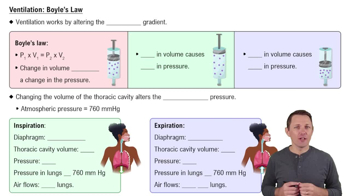
Understand Boyle's Law: Boyle's Law states that the pressure of a gas is inversely proportional to its volume, provided the temperature remains constant. Mathematically, this can be expressed as: P×V=k, where P is pressure, V is volume, and k is a constant.
Relate Boyle's Law to respiration: During respiration, the lungs act as a container for air, and changes in lung volume directly affect air pressure inside the lungs. This relationship is crucial for the movement of air in and out of the lungs.
Explain inhalation: During inhalation, the diaphragm contracts and moves downward, while the intercostal muscles expand the rib cage. This increases the volume of the thoracic cavity and lungs. According to Boyle's Law, as lung volume increases, the pressure inside the lungs decreases, creating a pressure gradient that allows air to flow into the lungs from the higher-pressure atmosphere.
Explain exhalation: During exhalation, the diaphragm relaxes and moves upward, and the rib cage returns to its resting position. This decreases the volume of the thoracic cavity and lungs. As lung volume decreases, the pressure inside the lungs increases, forcing air out of the lungs into the lower-pressure atmosphere.
Summarize the significance: Boyle's Law is fundamental to the mechanics of breathing, as it explains how changes in lung volume create pressure gradients that drive the movement of air during inhalation and exhalation. Without this principle, the process of respiration would not function effectively.

Verified video answer for a similar problem:

This video solution was recommended by our tutors as helpful for the problem above.
Was this helpful?

Key Concepts

Here are the essential concepts you must grasp in order to answer the question correctly.

Boyle's Law

Boyle's Law states that the pressure of a gas is inversely proportional to its volume when temperature is held constant. This means that as the volume of a gas decreases, its pressure increases, and vice versa. This principle is fundamental in understanding how gases behave under varying conditions, particularly in closed systems.
Recommended video:
Guided course
4:23
Ventilation: Boyle’s Law

Respiration Mechanics

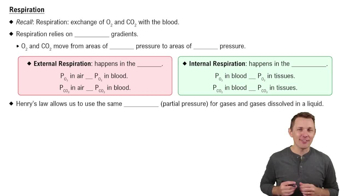
Respiration involves the exchange of gases, primarily oxygen and carbon dioxide, between the body and the environment. The mechanics of respiration include inhalation and exhalation, which are driven by changes in lung volume and pressure. Understanding these mechanics is crucial for grasping how Boyle's Law applies to the respiratory process.
Recommended video:

Intrapulmonary Pressure

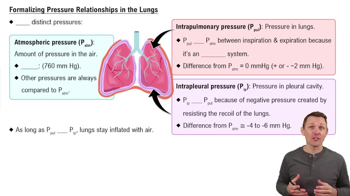
Intrapulmonary pressure refers to the pressure within the lungs during the breathing cycle. During inhalation, the diaphragm contracts, increasing lung volume and decreasing intrapulmonary pressure, allowing air to flow in. Conversely, during exhalation, lung volume decreases, increasing pressure and pushing air out, illustrating the application of Boyle's Law in respiration.
Recommended video:
Guided course
5:46
Formalizing Pressure Relationships in the Lungs