Ch. 28 Pregnancy and Human Development

Marieb, Hoehn11th EditionHuman Anatomy & PhysiologyISBN: 9780136874034
Not the one you use?Change textbookSelect a different textbook
Table of contents
- Ch. 1 The Human Body: An Orientation24
- Ch. 2 Chemistry Comes Alive25
- Ch. 3 Cells: The Living Units21
- Ch. 4 Tissue: The Living Fabric20
- Ch. 5 The Integumentary System11
- Ch. 6 Bones and Skeletal Tissues19
- Ch. 7 The Skeleton14
- Ch. 8 Joints7
- Ch. 9 Muscles and Muscle Tissue26
- Ch. 10 The Muscular System26
- Ch. 11 Fundamentals of the Nervous System and Nervous Tissue19
- Ch. 12 The Central Nervous System26
- Ch. 13 The Peripheral Nervous System and Reflex Activity32
- Ch. 14 The Autonomic Nervous System19
- Ch. 15 The Special Senses26
- Ch. 16 The Endocrine System23
- Ch. 17 Blood25
- Ch. 18 The Cardiovascular System: The Heart24
- Ch. 19 The Cardiovascular System: Blood Vessels27
- Ch. 20 The Lymphatic System and Lymphoid Organs and Tissues14
- Ch. 21 The Immune System: Innate and Adaptive Body Defenses27
- Ch. 22 The Respiratory System21
- Ch. 23 The Digestive System31
- Ch. 24 Nutrition, Metabolism, and Energy Balance26
- Ch. 25 The Urinary System26
- Ch. 26 Fluid, Electrolyte, and Acid-Base Balance24
- Ch. 27 The Reproductive System24
- Ch. 28 Pregnancy and Human Development25
- Ch. 29 Heredity11
Marieb, Hoehn11th EditionHuman Anatomy & PhysiologyISBN: 9780136874034Not the one you use?Change textbook

Chapter 28, Problem 3
The outer layer of the blastocyst, which later attaches to the uterus, is the
(a) decidua
(b) trophoblast
(c) amnion
(d) embryoblast
 Verified step by step guidance
1
Step 1: Understand the structure of the blastocyst. The blastocyst is an early stage in embryonic development, consisting of an outer layer and an inner cell mass.
Step 2: Identify the function of the outer layer of the blastocyst. This layer is responsible for attaching the blastocyst to the uterine wall and eventually contributes to forming the placenta.
Step 3: Review the options given: (a) decidua, (b) trophoblast, (c) amnion, and (d) embryoblast. Recall that the decidua is the uterine lining, the amnion is a membrane surrounding the embryo, and the embryoblast is the inner cell mass that forms the embryo.
Step 4: Recognize that the trophoblast is the outer layer of the blastocyst that attaches to the uterus and helps form the placenta.
Step 5: Conclude that the correct answer is the trophoblast, as it matches the description of the outer layer of the blastocyst responsible for uterine attachment.
Key Concepts
Here are the essential concepts you must grasp in order to answer the question correctly.
Blastocyst Structure
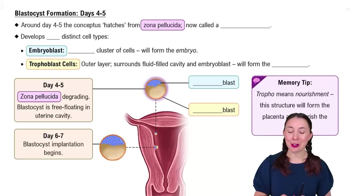
The blastocyst is an early stage embryo consisting of an outer layer and an inner cell mass. The outer layer surrounds the fluid-filled cavity and plays a key role in implantation, while the inner cell mass develops into the embryo itself.
Recommended video:
 2:18
2:18
Blastocyst Formation: Days 4-5
Trophoblast Function
The trophoblast is the outer layer of the blastocyst that facilitates attachment to the uterine wall. It later contributes to forming the placenta, supporting nutrient exchange between mother and embryo.
Recommended video:
Guided course
 06:04
06:04Functional Groups
Decidua and Amnion
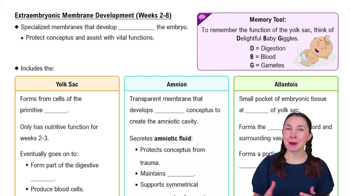
The decidua is the modified uterine lining during pregnancy, not part of the blastocyst. The amnion is a membrane that forms later to enclose the amniotic cavity, protecting the embryo but is not the outer blastocyst layer.
Recommended video:
 5:24
5:24Extraembryonic Membrane Development (Weeks 2-8)
Related Practice