Which of the following clues would tell you whether a cell is prokaryotic or eukaryotic?
a. the presence or absence of a rigid cell wall
b. whether or not the cell is partitioned by internal membranes
c. the presence or absence of ribosomes
d. Both b and c are important clues.
Verified step by step guidance
1
Identify the key differences between prokaryotic and eukaryotic cells.
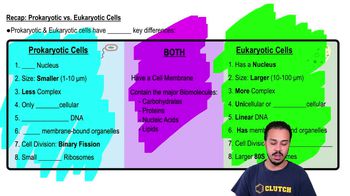
Understand that prokaryotic cells do not have membrane-bound organelles, while eukaryotic cells do.
Recognize that the presence of internal membranes is a characteristic of eukaryotic cells.
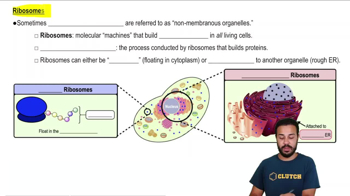
Note that both prokaryotic and eukaryotic cells have ribosomes, so their presence is not a distinguishing factor.
Conclude that the presence of internal membranes (option b) is a clue to identify a eukaryotic cell.
Verified video answer for a similar problem:
This video solution was recommended by our tutors as helpful for the problem above.
Video duration:
1m
Play a video:
0 Comments
Key Concepts
Here are the essential concepts you must grasp in order to answer the question correctly.
Prokaryotic vs. Eukaryotic Cells
Prokaryotic cells are simple, unicellular organisms without a nucleus or membrane-bound organelles, while eukaryotic cells are more complex, containing a nucleus and various organelles. This fundamental distinction is crucial for understanding cellular biology and the organization of life forms.
The presence or absence of a rigid cell wall is a significant characteristic that can help differentiate between prokaryotic and eukaryotic cells. Many prokaryotes, such as bacteria, have a cell wall made of peptidoglycan, while most eukaryotic cells, like plant cells, have a cellulose-based wall, and animal cells lack a cell wall entirely.
The presence of internal membranes is a key feature of eukaryotic cells, which compartmentalize cellular functions, while prokaryotic cells lack such structures. Ribosomes, present in both cell types, are essential for protein synthesis, but their size and location can provide clues about the cell type, with eukaryotic ribosomes being larger and found in the cytoplasm or attached to the endoplasmic reticulum.

 1:19 minutes
 Verified step by step guidance
 04:26
04:26