Mark the following statements as true or false. If a statement is false, correct it to make a true statement. The concentration of Na+ is highest in the cytosol, and the concentration of K+ is highest in the extracellular fluid.
Verified step by step guidance
1
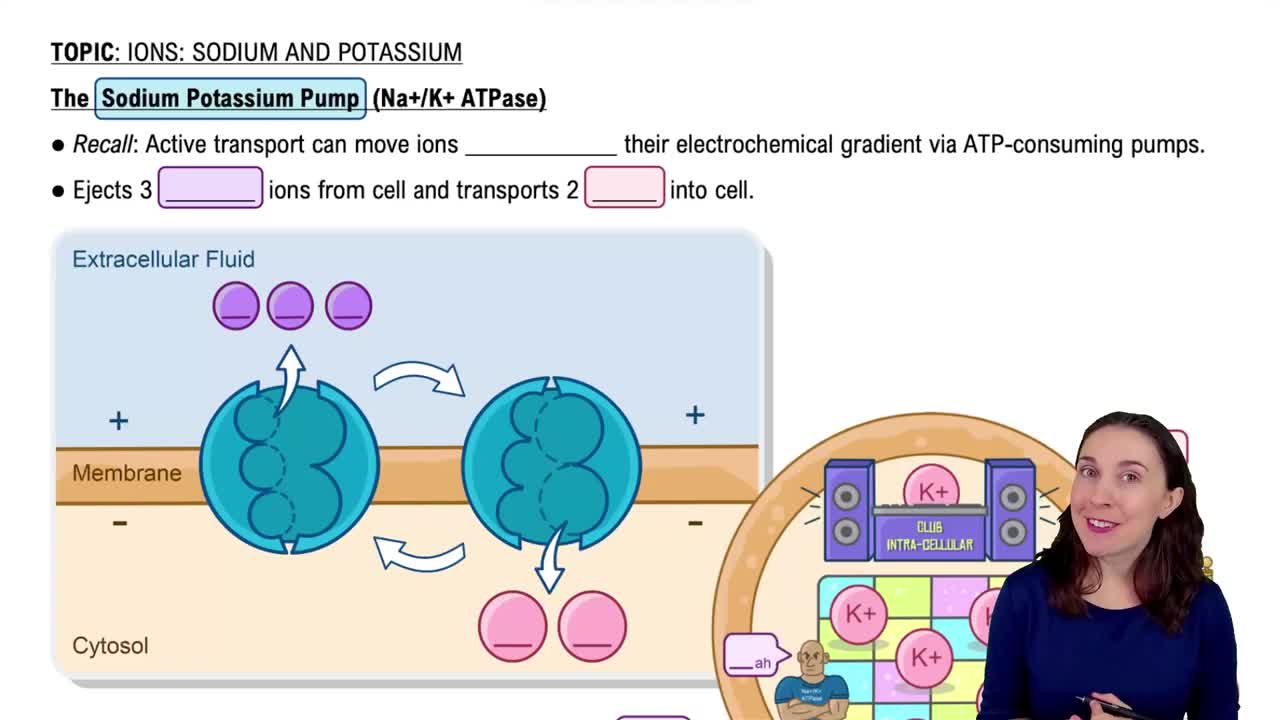
Step 1: Understand the context of the problem. The question is about the distribution of sodium ions (Na⁺) and potassium ions (K⁺) across the cell membrane, which is a fundamental concept in cell physiology. This distribution is maintained by the sodium-potassium pump (Na⁺/K⁺ ATPase).
Step 2: Recall the normal distribution of ions. Sodium ions (Na⁺) are typically found in higher concentrations in the extracellular fluid (outside the cell), while potassium ions (K⁺) are found in higher concentrations in the cytosol (inside the cell).
Step 3: Analyze the given statement. The statement claims that the concentration of Na⁺ is highest in the cytosol and the concentration of K⁺ is highest in the extracellular fluid. Compare this with the normal distribution of ions to determine if the statement is true or false.
Step 4: If the statement is false, correct it. Based on the normal distribution, the corrected statement should reflect that the concentration of Na⁺ is highest in the extracellular fluid, and the concentration of K⁺ is highest in the cytosol.
Step 5: Conclude your analysis. Clearly mark the original statement as true or false, and if false, provide the corrected version as part of your final answer.
Verified video answer for a similar problem:
This video solution was recommended by our tutors as helpful for the problem above
Play a video:
0 Comments
Key Concepts
Here are the essential concepts you must grasp in order to answer the question correctly.
Ion Concentration Gradients
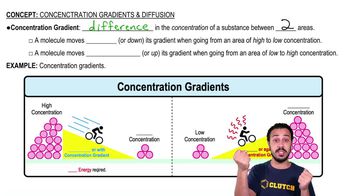
Ion concentration gradients refer to the differences in the concentration of ions across a membrane, which are crucial for cellular function. In most cells, sodium (Na<sup>+</sup>) is more concentrated outside the cell, while potassium (K<sup>+</sup>) is more concentrated inside. This gradient is essential for processes like action potentials in neurons and muscle contraction.
The sodium-potassium pump is a vital membrane protein that actively transports Na<sup>+</sup> out of the cell and K<sup>+</sup> into the cell, maintaining the necessary concentration gradients. This pump uses ATP to function, moving three Na<sup>+</sup> ions out for every two K<sup>+</sup> ions it brings in, which is critical for maintaining cellular homeostasis and electrical excitability.
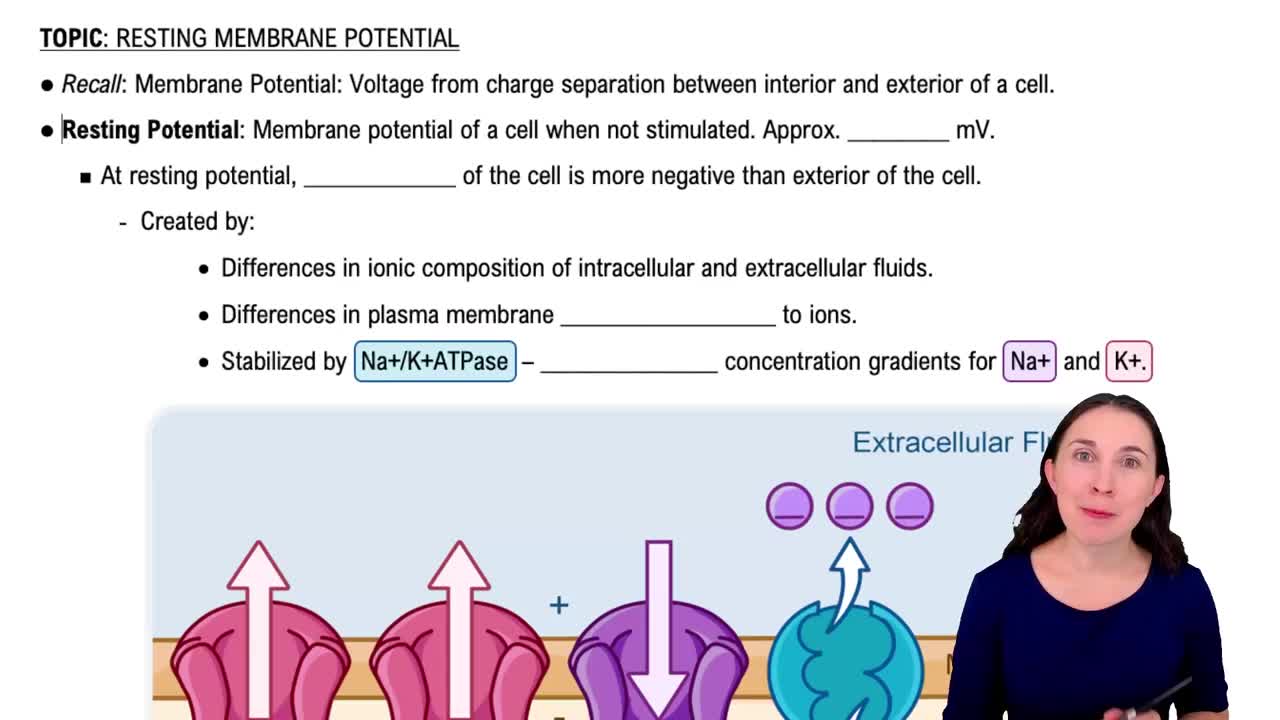
Cell membrane potential is the voltage difference across a cell's membrane, resulting from the uneven distribution of ions. This potential is crucial for the generation of action potentials in excitable cells, such as neurons and muscle cells. The resting membrane potential is typically negative, influenced by the higher concentration of K<sup>+</sup> inside the cell compared to Na<sup>+</sup> outside.