Back

The Reaction Quotient quiz

Control buttons has been changed to "navigation" mode.
1/15
  • What does the reaction quotient (Q) help us determine in a chemical reaction?

    Q helps us determine if a chemical reaction is at equilibrium.
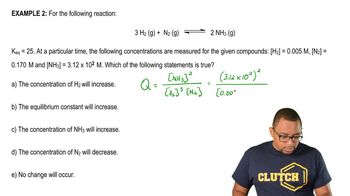
  • How is the reaction quotient (Q) calculated?

    Q is calculated as the concentration of products over the concentration of reactants, ignoring solids and liquids.
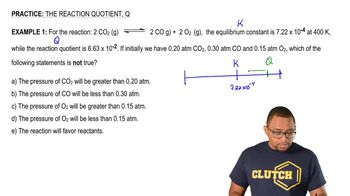
  • What does it mean if Q equals the equilibrium constant (K)?

    If Q equals K, the reaction is at equilibrium and no shift will occur.
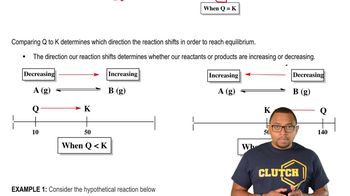
  • What happens if Q is less than K?

    If Q is less than K, the reaction will shift forward (toward products) to reach equilibrium.
  • What happens if Q is greater than K?

    If Q is greater than K, the reaction will shift backward (toward reactants) to reach equilibrium.
  • When calculating Q, which phases of matter are ignored?

    Solids and liquids are ignored when calculating Q.
  • If a reaction shifts toward the products, what happens to the amount of products and reactants?

    The amount of products increases while the amount of reactants decreases.
  • If a reaction shifts toward the reactants, what happens to the amount of reactants and products?

    The amount of reactants increases while the amount of products decreases.
  • What is the relationship between Q and K at equilibrium?

    At equilibrium, Q equals K.
  • Why does Q always shift to reach K?

    Q shifts to reach K because the system seeks equilibrium.
  • In the expression for Q, what would the formula be for the reaction A(g) ⇌ B(g)?

    The formula for Q would be [B]/[A].
  • If Q is calculated to be 10 and K is 50, which direction will the reaction shift?

    The reaction will shift forward, toward the products, to reach equilibrium.
  • If Q is calculated to be 140 and K is 50, which direction will the reaction shift?

    The reaction will shift backward, toward the reactants, to reach equilibrium.
  • What does it mean for the system if both sides of a reaction were increasing or decreasing together?

    It would disrupt the balance; only one side can increase while the other decreases.
  • What fundamental steps should you follow to determine the direction of a reaction shift?

    Calculate Q, compare it to K, and determine which direction the reaction must shift to reach equilibrium.